






Archive Updates
Track the latest additions to the ADAM Archive. Browse files by the date they were added to see what's new in our collection.
Select Date to View Files
11/14/2026[111]11/04/2026[240]11/03/2026[279]10/28/2026[147]09/10/2026[32]07/26/2026[127]06/19/2026[47]06/11/2026[72]05/12/2026[51]03/19/2026[72]03/10/2026[88]02/19/2026[86]02/07/2026[49]01/07/2026[57]12/31/2025[93]12/22/2025[32]12/17/2025[123]09/21/2025[138]04/07/2025[87]02/07/2025[16]01/25/2025[19]01/24/2025[19]01/14/2025[160]12/21/2024[41]12/18/2024[135]
Files Added on 11/14/2026
| Name | Publisher | Size | Actions | Screenshots (Only Partially Available In Some Browsers) |
|---|---|---|---|---|

Every ColecoVision magazine adaptation in this folder in one download: 3 games adapted from programs published in RUN magazine, made by Amy Studio/Amy Purple (Bienvenu). Each ROM inside carries its archive name, Title (Year) (Maker) (Run).rom. _Index.txt pairs every ROM with its original release file name, which records the publication number, original author and magazine issue.
|
Amy Studio/Amy Purple (Bienvenu) | 39kb | — |
|

You are lost in the catacombs of Lladnar Castle, twenty levels down, with 100 energy and 12 spells. Climb the stairs and find the way out before the castle's demons and monsters finish you. Any move can bring a wandering monster. At a door you can listen, ask for help to learn the strength of whatever waits inside, go in or leave; the cells are your only source of energy, spells and gold. A fight costs you the monster's energy, and if it has more than you, you die. A spell may destroy it, and a failed spell can be cast again. Retreat and you drop a level, and the monster may chase you anyway. Walls drop rocks, stairs down lead away from the exit, a coward's retreat can open a trap door, and an elevator can lift you several levels at once. Hard by design: careful play escapes only a few times in a hundred.
The ColecoVision version draws every room as a perspective corridor with its doors, stairs and passages, and adds 13 large monster pictures for the original's 101 encounters, tinted in the colours the original printed their names in. The original's story is kept as The Legend (20 pages), joystick menus replace the letter keys, and "Lladnar's March" plays on the title. The original crashed with OUT OF MEMORY after 118 to 158 moves, because GOTOs left its subroutines without a RETURN; that is fixed here. Controls: the joystick moves through the menus and the button chooses. ColecoVision version credited in the source to Claude (an AI made by Anthropic) for Amy Studio, in Amy, the language by Amy Bienvenu, 2026: a faithful adaptation of the original program. From RUN magazine's Special Edition ReRUN Game Pak: original Commodore 64 BASIC program by Fred S. Randall. The author's postal address and phone number in the original listing are left out. This is a modern homebrew adaptation, not a commercial Coleco release. |
Amy Studio/Amy Purple (Bienvenu) | 31kb | 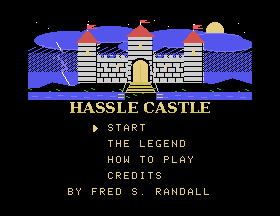 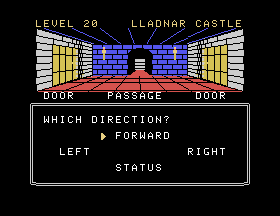 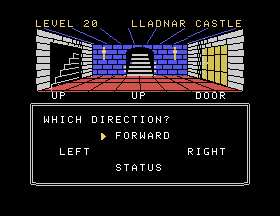 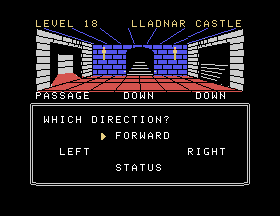 |
|
|
Ribbit the frog sits on a log. Dragonflies come down from the sky and flutter about, and the button shoots his tongue straight up to swat one, for 10 points times the level. A swatted fly jumps and drops, so dodge it. A snake wanders the log with its head bobbing: hop over it. Touch the snake or a fly and Ribbit hops away, and that frog is lost. You have three frogs, with one more every 2,000 points. Catch all the flies of a level, 13 to 20 of them, to go on to the next, faster level; there are 15.
The rules are the original machine code's own, kept in its units: the Commodore 64 screen positions, the main loop's timing and random choices, and its pixel-exact collisions, with the original sprite shapes kept as masks. The port runs the same number of game-loop passes per frame as a real NTSC Commodore 64. New pictures of the sky, log and reeds, a title picture, a title menu with HOW TO PLAY and CREDITS, and an original title tune are added; the original's pause and RUN/STOP keys are left out. Controls: either controller. The joystick walks left and right; up hops in place, and up-left or up-right hops over the snake. Either button shoots the tongue. ColecoVision version credited in the source to Claude (an AI made by Anthropic) for Amy Studio, in Amy, the language by Amy Bienvenu, 2026: a faithful adaptation of the original program. From RUN magazine's July/August 1992 ReRUN disk: original Commodore 64 machine-language program by Tony Brantner. This is a modern homebrew adaptation, not a commercial Coleco release. |
Amy Studio/Amy Purple (Bienvenu) | 17kb | 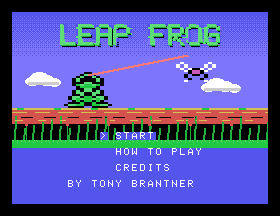 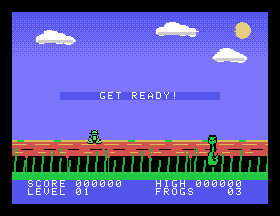 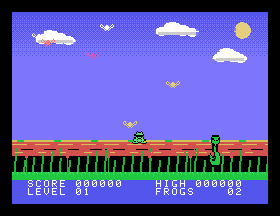 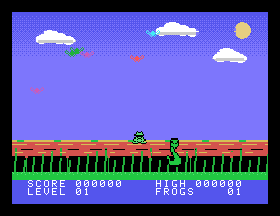 |
|
|
Gold nuggets drop from the roof of the cave. As Flynn, catch each one, carry it to the mine and press the button to bank it. Two 10-ton weights and a bat come down out of the dark, and a hit costs Flynn a life and the nugget he is carrying. Bank 25 nuggets to end the game with a bonus. Choose a level from 1 to 9 on the title screen; the higher levels are faster and score more. A short original tune, "Prospector's Jig", plays on the title.
The port keeps the original's positions, contact rules and quirks: bots played the Commodore 64 original to measure its speeds, drop timing and catch, bank and death rates at every level, and the ColecoVision version matches them. Controls: the joystick moves Flynn; the button banks a nugget at the mine. ColecoVision version credited in the source to Claude (an AI made by Anthropic) for Amy Studio, in Amy, the language by Amy Bienvenu, 2026: a faithful adaptation of the original program. From RUN magazine's Fall 1985 ReRUN disk: original Commodore 64 program by Pasquale Longo. This is a modern homebrew adaptation, not a commercial Coleco release. |
Amy Studio/Amy Purple (Bienvenu) | 10kb | 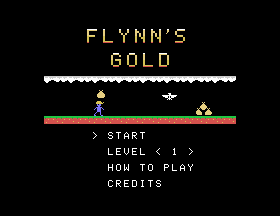 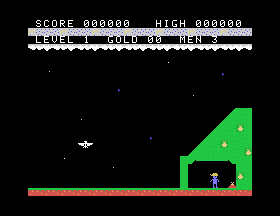 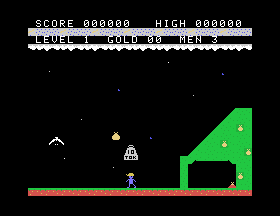 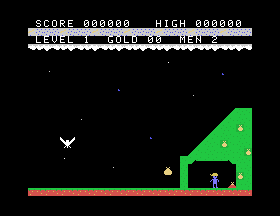 |
|
| 720kb | 📄 Click to preview |
|||
| 160kb | — |
|||
| 256kb | — |
|||
| 32kb | — |
|||

A 2026 preview of SmartBASIC 2.0 running natively in 80 columns on an ADAM fitted with an F18A or Pico9918 video board. TEXT selects the 80-column screen, and HTAB counts from zero.
The disk (volume ADAM+) carries test programs dated 23 October 2026. DEMO80 and AUTO80 show a column ruler, inverse and flashing text, colour changes, GR, HGR and HGR2 graphics, and a scroll test. TESTIO is a disk self-test that writes only files named T80 on drive 5. PRTEST is an optional printer test for the ADAM+ printer window. EXTTEST checks extended memory, and STRTST stresses string arrays for comparison with the original SmartBASIC 2.0. |
Danny Van Den Heuvel | 160kb | — |
|
| 160kb | — |
|||
|
📁 ColecoVision/Cartridges/1996-202x - Magazine Adaptations/Tim Hartnell's Giant Book of Computer Games
An explorer is trapped somewhere in the tunnels of the Pharaoh's tomb, a block ten squares high, ten wide and ten deep inside Egypt's greatest pyramid, with only a little air. He is knocking on the side of the tomb, and you follow the sound. Stone muffles it: each part of the answer, above or below and left or right, is heard correctly only seven times in ten, though ahead or behind always comes through. Each move takes one minute, and you must reach him within twenty.
The front view shows the tunnels at every depth, and a gauge at the right shows how deep you are. Your torch lights the blocks around you, and squares you have crossed stay marked. The ColecoVision version lets you hear the knocks as well as read them, louder as you come nearer, cuts the book's long opening text to its essentials on the rules page, and adds new music (Valley of the Kings) and sound effects. Controls: either joystick. The stick moves you up, down, left or right; the left button goes forward (deeper) and the right button goes back. The keypad is not used. ColecoVision version credited in the source to Amy Bienvenu for Amy Studio, written in Amy, her own language, 2026: an adaptation of a BASIC program from Tim Hartnell's Giant Book of Computer Games (Ballantine Books, 1984; first published by Interface Publications, 1983). This is a modern homebrew adaptation, not a commercial Coleco release. |
Amy Studio/Amy Purple (Bienvenu) | 7kb | 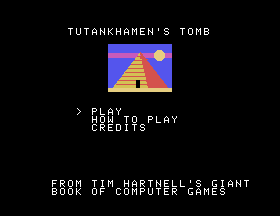 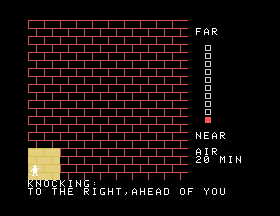 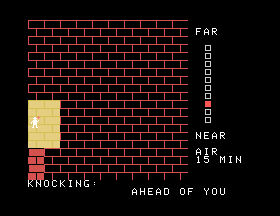 |
|
|
📁 ColecoVision/Cartridges/1996-202x - Magazine Adaptations/Tim Hartnell's Giant Book of Computer Games
Explore the caves of Dragonworld, an 8 by 8 grid, looking for treasure and slaying the dragons who live there. You start in cave 55 with 25 units of charisma and lose one for every move. Among the caves are solid walls, magic caves that whisk you somewhere else, dragons' lairs, quicksand and hoards of dragon-gold. Your magic amulet tells you what lies in one of the eight caves around you, but not which one, and from time to time you get a glimpse of the whole cave system.
The book's dragon fight was broken: it reset your charisma and used an unset variable, so a dragon that did not fly away always killed you. Here a dragon flies away one time in five, has recently eaten and goes back to sleep in 15 per cent of the rest, and you fight back and win one time in twenty, as the book's text intends. Each ending now says what happened, caves you have visited stay shown on the map, and the best haul of gold is kept. New music (Dragonworld) and sound effects are added. Controls: either joystick. The stick moves you north, south, east or west and picks your name on the first screen; the button fights a dragon, and the stick then aims the arrow; the second button quits. The keypad is not used. ColecoVision version credited in the source to Amy Bienvenu for Amy Studio, written in Amy, her own language, 2026: an adaptation of a BASIC program from Tim Hartnell's Giant Book of Computer Games (Ballantine Books, 1984; first published by Interface Publications, 1983). The book's game is a development of Gregory Yob's Hunt the Wumpus (1975). This is a modern homebrew adaptation, not a commercial Coleco release. |
Amy Studio/Amy Purple (Bienvenu) | 17kb | 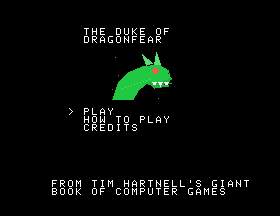 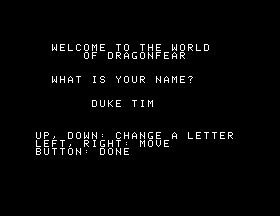 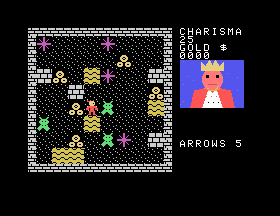 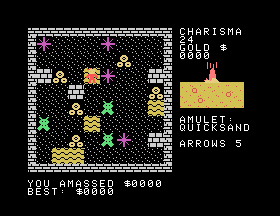 |
|
|
📁 ColecoVision/Cartridges/1996-202x - Magazine Adaptations/Tim Hartnell's Giant Book of Computer Games
Deep in a 15 by 15 cavern lies the Dwarven gold, in one of three places: the north-east, north-west or south-east corner. You start in the south-west, and your only clue is the Dwarven Source Beam, which after each step reads 100 times the north-south distance to the gold plus 10 times the east-west distance. Find the gold in as few steps as you can. The map shows the cavern and where you are, never the gold; you see it once for free at the start, and every later look costs 15 steps. The cavern is built as in the book, from its fixed passages plus a fifth of the other squares opened at random, and the gold's place is chosen at random.
The book printed your surroundings as text and suggested turning them into a 3D maze; this version does that, with a first-person view and the four directions still listed beside it. Because you now face a direction, turning is new, and free. The book's data opened only 68 of its 69 passage squares, leaving out the north-east gold's own square; all 69 are opened here so the gold can always be reached. The gold shows in the view when it is straight ahead, the end map shows where it was, and the best (lowest) number of steps is kept. New music (Under the Mountain) and sound effects are added. Controls: either joystick. Up steps forward, down steps back, left and right turn. Either button looks at the map (15 steps). The keypad is not used. ColecoVision version credited in the source to Amy Bienvenu for Amy Studio, written in Amy, her own language, 2026: an adaptation of a BASIC program from Tim Hartnell's Giant Book of Computer Games (Ballantine Books, 1984; first published by Interface Publications, 1983). This is a modern homebrew adaptation, not a commercial Coleco release. |
Amy Studio/Amy Purple (Bienvenu) | 8kb | 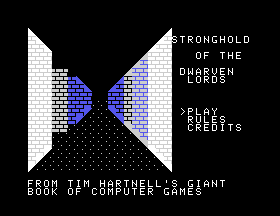 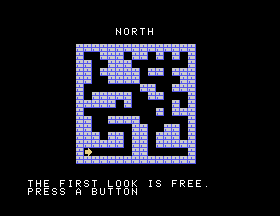 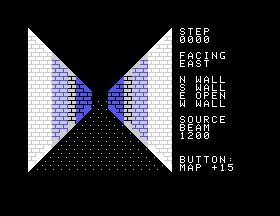 |
|
|
📁 ColecoVision/Cartridges/1996-202x - Magazine Adaptations/Tim Hartnell's Giant Book of Computer Games
You are trapped in a walled field with twenty mines and four manic robots, all bent on your destruction. The robots come straight at you but cannot see the mines: put a mine between you and them and they will smash into it. Mines are deadly to you too. Robots can merge into one another and split again at the last moment. Wreck all four to win.
The robots move as the book's do: a step toward you each turn, every time when they are above you or to your right, seven times in ten when they are below you or to your left. They move first, then you. The ColecoVision version shows a wrecked robot on its mine (the book showed only the mine, which is still there and still deadly), counts wins and losses, and adds new music (Clockwork March) and sound effects. Controls: either joystick. The stick moves you one square north, south, east or west. The keypad is not used. ColecoVision version credited in the source to Amy Bienvenu for Amy Studio, written in Amy, her own language, 2026: an adaptation of a BASIC program from Tim Hartnell's Giant Book of Computer Games (Ballantine Books, 1984; first published by Interface Publications, 1983). This is a modern homebrew adaptation, not a commercial Coleco release. |
Amy Studio/Amy Purple (Bienvenu) | 8kb | 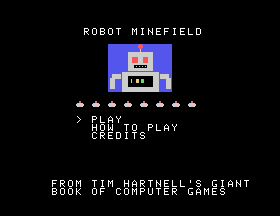 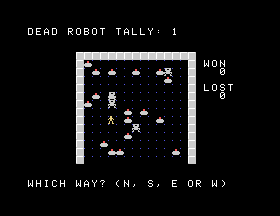 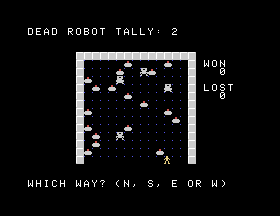 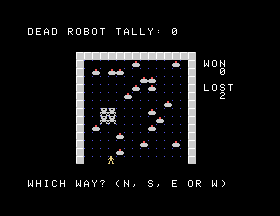 |
|
|
📁 ColecoVision/Cartridges/1996-202x - Magazine Adaptations/Tim Hartnell's Giant Book of Computer Games
Three board games from the book on one cartridge, each played against the computer, with a first menu to pick the game and an OTHER GAME choice on each title screen to come back to it.
Shogun, based on the Japanese game Hasami Shogi: your white pieces start at the bottom, the computer's black ones at the top. A piece moves in a straight line, not on the diagonal, over empty squares, or jumps a piece next to it. Squeeze an enemy piece between two of yours to take it; moving between two is safe. The first to take six wins. There are BOOK and MASTER levels. Gomoku, based on a program by Graham Charlton: take turns placing stones on the points of the board, white for you and black for the computer. Five in a line, across, up and down or diagonally, wins. You can choose to go first or let the computer start. Knightsbridge, a game invented by Tim Hartnell: all the pieces are knights and move as in chess. Each turn, chance picks the knight that must move. Land on an enemy knight to take it; the first to take five wins. There are BOOK and MASTER levels. Each game has new music: Edge of the Board, Stones in the Garden and Kensington Gallop. Controls: in Shogun the button picks a piece, then its square. In Gomoku the stick moves the cursor and the button places a stone. In Knightsbridge the stick moves the cursor and the button sends your knight to a marked square or onto an enemy. The keypad is not used. ColecoVision version credited in the source to Amy Bienvenu for Amy Studio, written in Amy, her own language, 2026: an adaptation of a BASIC program from Tim Hartnell's Giant Book of Computer Games (Ballantine Books, 1984; first published by Interface Publications, 1983). Gomoku is based on a program by Graham Charlton, and Knightsbridge was invented by Tim Hartnell. This is a modern homebrew adaptation, not a commercial Coleco release. |
Amy Studio/Amy Purple (Bienvenu) | 21kb | 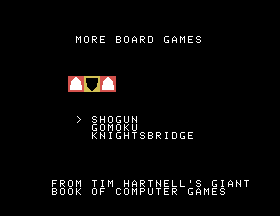 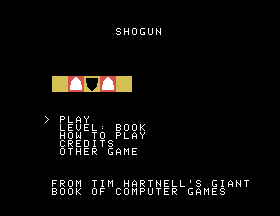 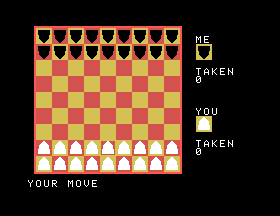 |
|
|
📁 ColecoVision/Cartridges/1996-202x - Magazine Adaptations/Tim Hartnell's Giant Book of Computer Games
Two lunar-landing games from the book on one cartridge. Land on the moon with limited fuel. You are told your height, your speed (negative when falling) and your fuel. Each burn of thrust uses that much fuel; the moon pulls with 5 units, so a thrust of 5 holds your speed and more slows your fall. Touch down under 20 metres with a speed under 15 to land safely, and your galactic rating is your fuel left times 234. A crash rates 100 less your speed and leaves a crater 45 metres deep for every kph.
In MOONLANDER you choose the thrust for each step, then fire. In REALTIME LANDER, for experienced space jockeys, the craft falls on its own and you set a throttle from 0 to 9, each notch burning 1.7 units a step. It starts still, higher and with more fuel, and is more forgiving at the bottom: under 40 metres with a speed under 25. The book ended the flight the moment the fuel ran out above 100 metres; here the craft falls the rest of the way and is judged when it hits. The realtime throttle stays where you set it (the book read a key each step), and height, speed and fuel keep their tenths. The book's lander was a text character jumping about the screen; here it is drawn over the moon with its flame. New music (Tranquillity) and sound effects are added. Controls: either joystick. In MOONLANDER the stick chooses the thrust and the button fires it; in REALTIME LANDER the stick sets the throttle and the button cuts it. The second button returns to the title between missions. The keypad is not used. ColecoVision version credited in the source to Amy Bienvenu for Amy Studio, written in Amy, her own language, 2026: an adaptation of a BASIC program from Tim Hartnell's Giant Book of Computer Games (Ballantine Books, 1984; first published by Interface Publications, 1983). It combines the book's MOONLANDER and REALTIME LANDER. This is a modern homebrew adaptation, not a commercial Coleco release. |
Amy Studio/Amy Purple (Bienvenu) | 9kb | 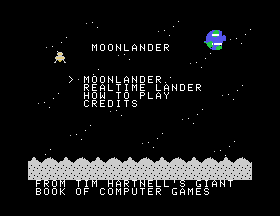 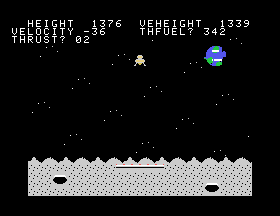 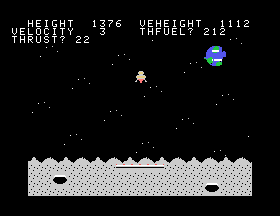 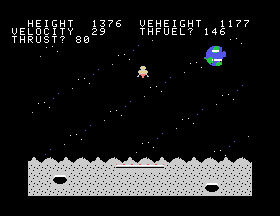 |
|
|
📁 ColecoVision/Cartridges/1996-202x - Magazine Adaptations/Tim Hartnell's Giant Book of Computer Games
You play white against the computer's black on an eight by eight board that starts with two pieces each in the centre. Put a piece so that one or more lines of computer pieces lie between it and another of yours, across, down or on the diagonals, and they all turn over. The game ends when the board is full or neither side can move, and the most pieces wins.
On the CLASSIC level the computer plays as the book's program does: for each free square it counts the pieces it would turn, doubles that on the edges, halves it on the squares next to the edges and halves it again beside the corners, and plays the best square, choosing at random between equal ones three times out of ten. A new MASTER level also looks at your best answer to each of its moves and avoids giving it. Small dots show where you can play, a turn you cannot play is passed for you (the book asked you to type 0), and the pieces turn over in steps. New music (Queen's Gambit Rag) is added. Controls: either joystick. The stick moves the cursor; a side button plays the square. The keypad is not used. ColecoVision version credited in the source to Amy Bienvenu for Amy Studio, written in Amy, her own language, 2026: an adaptation of a BASIC program from Tim Hartnell's Giant Book of Computer Games (Ballantine Books, 1984; first published by Interface Publications, 1983). The book's program is based on one by Graham Charlton. This is a modern homebrew adaptation, not a commercial Coleco release. |
Amy Studio/Amy Purple (Bienvenu) | 8kb | 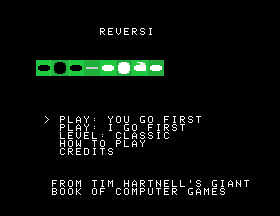 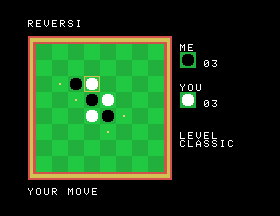 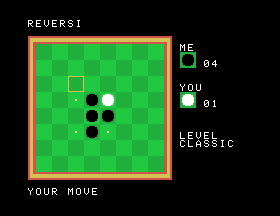 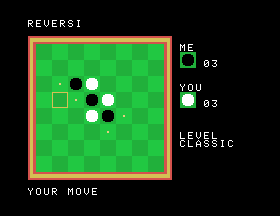 |
|
|
📁 ColecoVision/Cartridges/1996-202x - Magazine Adaptations/Tim Hartnell's Giant Book of Computer Games
You play white, moving up the board, against the computer's red. Pieces move one square diagonally forward and capture by jumping over an enemy piece into the empty square behind it, and another jump with the same piece may follow. A piece reaching the far row is crowned king and can move backward as well. Take all twelve enemy pieces, or leave the other side without a move, to win.
The computer plays as the book's program does, and moves first, as in the book. It looks at its pieces from the top of the board down and takes the first capture it finds, jumping again while it can; otherwise it moves a piece on its second row to be crowned; otherwise it picks at random among moves to squares where you cannot take it; otherwise any move; with no move at all it concedes. The ColecoVision version checks your moves (the book accepted any move). Captures are not compulsory for you, as in the book, while the computer always takes one. The pieces slide across the board, the book's "Good move" and "Got me" come back when you capture, and new music (Kings Row) and sound effects are added. Controls: either joystick. The stick moves the cursor; the left button picks a piece and then its square, and dots show where it can go. After a jump the piece stays picked for another jump, or the right button ends the turn. The right button with nothing picked offers to concede. The keypad is not used. ColecoVision version credited in the source to Amy Bienvenu for Amy Studio, written in Amy, her own language, 2026: an adaptation of a BASIC program from Tim Hartnell's Giant Book of Computer Games (Ballantine Books, 1984; first published by Interface Publications, 1983). This is a modern homebrew adaptation, not a commercial Coleco release. |
Amy Studio/Amy Purple (Bienvenu) | 9kb | 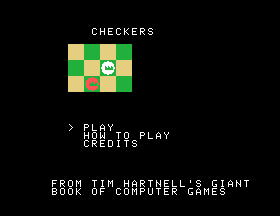 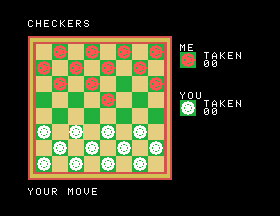 |
|
|
📁 ColecoVision/Cartridges/1996-202x - Magazine Adaptations/Tim Hartnell's Giant Book of Computer Games
Four board games from the book on one cartridge, each played against the computer, with a first menu to pick the game and an OTHER GAME choice on each title screen to come back to it.
Checkers: you play white up the board; pieces move diagonally forward, capture by jumping, may jump again, and are crowned on the far row. The computer plays as the book's program does. Reversi, based on a program by Graham Charlton: trap lines of the computer's pieces between two of yours to turn them over; dots show where you can play, and there are CLASSIC and MASTER levels. Awari, one of the mancala games: pick one of your six pits and its seeds are sown one by one into the next pits, clockwise; if the last seed falls in an empty pit, the seeds of the pit opposite go to your home, and when one side is empty the fuller home wins. Four in a Row: drop discs into the seven columns of an upright board, and four in a line, across, up and down or diagonally, wins; a full board is a draw. Awari and Four in a Row have BOOK and MASTER levels, and in Reversi, Awari and Four in a Row you can choose who goes first. Each game has its own new music. Controls: in Checkers the stick moves the cursor, the left button picks a piece and then its square, and the right button ends a jump or concedes. In Reversi the stick moves the cursor and the button plays. In Awari the stick picks a pit and the button sows it. In Four in a Row the stick chooses a column and the button drops the disc. The keypad is not used. ColecoVision version credited in the source to Amy Bienvenu for Amy Studio, written in Amy, her own language, 2026: an adaptation of a BASIC program from Tim Hartnell's Giant Book of Computer Games (Ballantine Books, 1984; first published by Interface Publications, 1983). Reversi is based on a program by Graham Charlton. This is a modern homebrew adaptation, not a commercial Coleco release. |
Amy Studio/Amy Purple (Bienvenu) | 30kb | 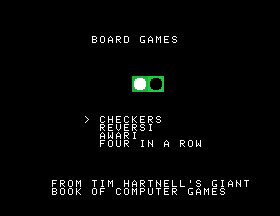 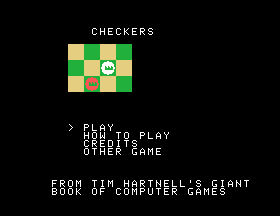 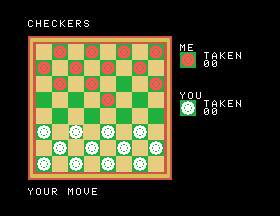 |
|
|
📁 ColecoVision/Cartridges/1996-202x - Magazine Adaptations/Tim Hartnell's Giant Book of Computer Games
Drop discs into the seven columns of an upright board; each falls to the lowest free place in its column. Four of your yellow discs in a line, across, up and down or diagonally, wins, and so do four of the computer's red. A full board is a draw.
On the BOOK level the computer plays as the book's "brute force" program: it scans the board from the top for a piece with a line of three that it can complete or must block, or a pair it can make into three, and with none it plays at random next to a piece already on the board. The new MASTER level first takes a winning place and blocks yours, then plays as the book. Two bugs in the book's checks are fixed: its vertical check looked below the top piece of a column, which was never true, and one of its across checks tested the wrong square for support. You may let the computer start, as the book suggested; its first disc then goes in the middle column. The winning line flashes, the discs fall, and new music (Drop Shuffle) and sound effects are added. Controls: either joystick. Left and right move the disc above the board, and the button drops it. The keypad is not used. ColecoVision version credited in the source to Amy Bienvenu for Amy Studio, written in Amy, her own language, 2026: an adaptation of a BASIC program from Tim Hartnell's Giant Book of Computer Games (Ballantine Books, 1984; first published by Interface Publications, 1983). This is a modern homebrew adaptation, not a commercial Coleco release. |
Amy Studio/Amy Purple (Bienvenu) | 6kb | 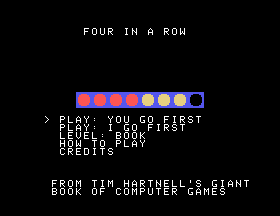 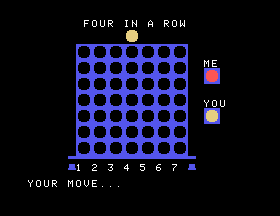 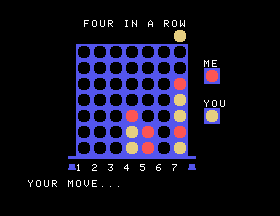 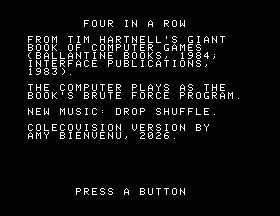 |
|
|
Two or three snakes, player 1 in red, player 2 in green and the computer in blue, crawl around a walled or wrap-around field leaving their bodies behind. A snake never stops, and running into a body, a block or the border ends that snake's round. Every move a snake survives scores a point, and the last snake alive doubles its round score. After the chosen number of rounds, the highest total wins.
The options set the players (player 1 against player 2, player 1 against the computer, or all three), the number of rounds, the tail length, the speed and speed-up, the border (off means wrap-around) and random blocks. The FIRE option decides what the button does: nothing, speed while held, hyperspace or skip (three per round), or leave spaces in your body. The speed is taken from the original's own timer, and the field is 28 by 21 cells to fit the screen, against the original's 40 by 23. Original title tunes were written for this version. Controls: controller 1 is player 1 and controller 2 is player 2. The stick steers the snake; the button does what the FIRE option says. The menus are worked with the joystick. ColecoVision version credited in the source to Claude (an AI made by Anthropic) for Amy Studio, in Amy, the language by Amy Bienvenu, 2026: a faithful adaptation of the original program. From RUN magazine's January/February 1991 ReRUN disk: original Commodore 64 program by Steve Harter. This is a modern homebrew adaptation, not a commercial Coleco release. |
Amy Studio/Amy Purple (Bienvenu) | 12kb | 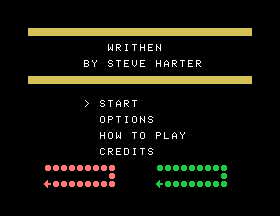 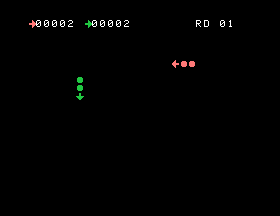 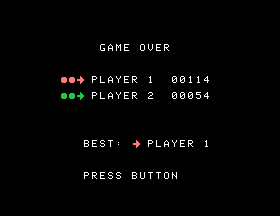 |
|
|
Fly through the caverns of Tundor and shoot the roving air mines, each worth 10 points times the level. Touching a wall or a mine costs a ship. You start with three ships and earn an extra one every 2,000 points. Each of the nine levels narrows the cavern and speeds up the scrolling, and when no ships are left the game is over.
The rules come from a disassembly of the original machine code: three ships, levels 1 to 9, a cavern gap of 13 rows less half the level, the original's mine timer and its scroll speed. The title tune is new. Controls: either controller. The stick moves the ship in four directions, and the button fires. ColecoVision version credited in the source to Claude (an AI made by Anthropic) for Amy Studio, in Amy, the language by Amy Bienvenu, 2026: a faithful adaptation of the original program. From RUN magazine's November/December 1992 ReRUN disk: original Commodore 64 machine-language program by Tony Brantner. This is a modern homebrew adaptation, not a commercial Coleco release. |
Amy Studio/Amy Purple (Bienvenu) | 8kb | 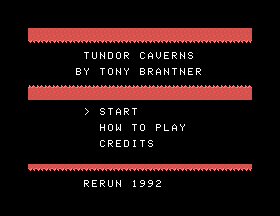 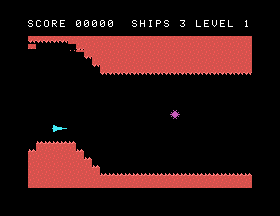 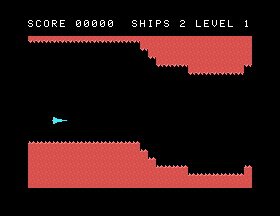 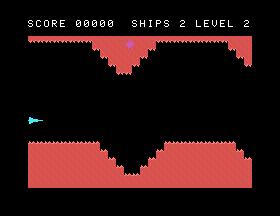 |
|
|
A rubber ball rolls round a closed arena of walls and bars. Roll it over all 95 dots before the 99-second timer runs out to reach the next level, where the bandits move faster and each dot is worth the level number. Two bandits roam the arena: one touch, or the timer reaching zero, costs a ball and puts every dot back. You have five balls, and the best scores go on a top-ten table, as in the original.
Pushing the stick speeds the ball up in that direction, through four speeds; pushing against its roll slows it down and stops it, and walls bounce it back. The rules come from the original's 6502 code, checked pass by pass against traces of the running Commodore 64 game, and keep its 80 by 100 arena and its scrolling. The ColecoVision version adds a title menu, how-to-play pages drawn with the game's own tiles and sprites, and a new title tune, since the original has no music. Controls: either controller. The stick pushes the ball; the button pauses the game. ColecoVision version credited in the source to Claude (an AI made by Anthropic) for Amy Studio, in Amy, the language by Amy Bienvenu, 2026: a faithful adaptation of the original program. From RUN magazine's September/October 1988 ReRUN disk: original Commodore 64 machine-language program by Charles Orcutt. This is a modern homebrew adaptation, not a commercial Coleco release. |
Amy Studio/Amy Purple (Bienvenu) | 18kb | 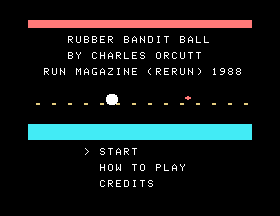 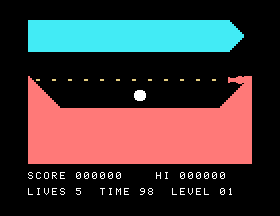 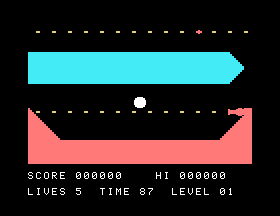 |
|
|
A roller-skater dashes along a brick wall. Each push of the stick to the right, then let go, is one stride, and stride after stride builds speed, which slowly runs down by itself. Stick up jumps the low obstacles and stick down ducks under the hanging banners; hitting anything drops your speed to a crawl. Cover 1.00 mile before the timer runs out. You score 10 points for every 0.01 mile and 100 points for every tick left on the timer. There are ten levels, each with five ticks less, and when the time runs out the game is over.
Timing is the original's: its main loop ran about 18 times every sixtieth of a second, measured in a Commodore 64 emulator, and the port runs that loop 18 times a frame so that every rule counts in the original's units. The game riff is from the Commodore 64 version; the title tune is new. Controls: either controller. Push the stick right and let go to stride; up jumps, down ducks. ColecoVision version credited in the source to Claude (an AI made by Anthropic) for Amy Studio, in Amy, the language by Amy Bienvenu, 2026: a faithful adaptation of the original program. From RUN magazine's September/October 1991 ReRUN disk: original Commodore 64 machine-language program; the disk does not credit an author. This is a modern homebrew adaptation, not a commercial Coleco release. |
Amy Studio/Amy Purple (Bienvenu) | 12kb | 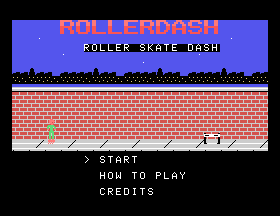 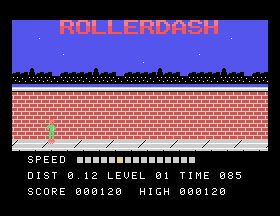 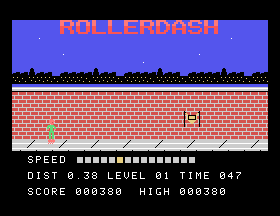 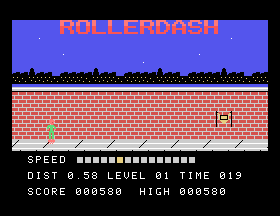 |
|
|
Your submarine hunts the Night Wolf fleet of submarines, battleships and aircraft carriers in a wrap-around tactical box. Enemy vessels are seen only inside your naval radar range, 35 units around the sub, and a vessel inside that range knows where you are, hunts you and fires a THUNDR-5 when it faces you; one hit sinks you. Surfacing or switching on the radar also gives your position away. The radar shows aircraft, which can drop depth charges only on a sub above 400 feet with its radar on; two charges sink you. Carriers launch helicopters, and jets fly by at random.
You carry three weapons: STINGER (1 point of damage), THUNDR-5 (2 points) and SAM (1 point, helicopters only), and you cannot fire below 400 feet. A submarine sinks after 2 points, a carrier after 3 and a battleship after 4. Sink the whole fleet to win; there is no score, as in the original. There are six fleets (levels) and six game speeds. The rules come from the article on the disk and the disassembled machine code. The ColecoVision version adds a title menu, how-to-play and credits pages, new side-view battle scenes and an original tune (Silent Running), and fixes several original bugs, among them an enemy that could circle for ever, broken diagonal wraps, wasted torpedoes and a jet depth charge that hit at any depth. Controls: controller 1 or 2. Stick left and right turn 45 degrees, up and down change speed by 10 knots, and button 1 fires the loaded tube. With button 2 held, stick down dives or stops, up climbs or stops, left loads the next weapon and right switches the radar. The keypad keeps the original's keys: 1 dive, 2 climb, 3 THUNDR-5, 4 STINGER, 5 SAM, 0 empties the tube, 7 radar, and * and # set the crosshair range. ColecoVision version credited in the source to Claude (an AI made by Anthropic) for Amy Studio, in Amy, the language by Amy Bienvenu, 2026: a faithful adaptation of the original program. From RUN magazine's March/April 1992 ReRUN disk: original Commodore 64 BASIC and machine-language program by Craig M. Buck. This is a modern homebrew adaptation, not a commercial Coleco release. |
Amy Studio/Amy Purple (Bienvenu) | 15kb | 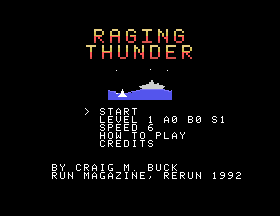 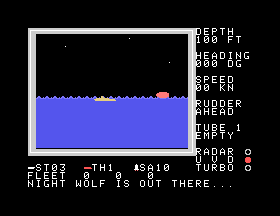 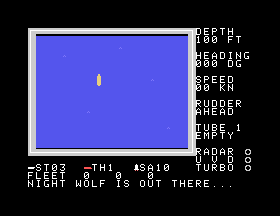 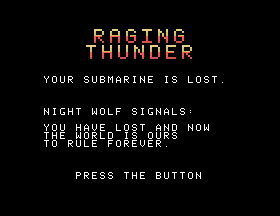 |
|
|
Two Vadraks, the albino (white) and the pigmented (gold), fly over a pit of lava. The button flaps the wings, once per press, and the stick steers: holding a direction keeps adding to the speed, and the speed stays. Gravity pulls all the time, and touching a ledge bounces a bird up. When the two birds touch, the lower one loses a point, and a bird that falls into the lava loses a point too; the loser starts again from the top. Each point moves a marker along the bottom row, and the albino wins at the left end, the pigmented at the right. The game gets faster as one bird leads.
The rules follow the original's machine code, checked against the running original with bots. New in the ColecoVision version: a one-player mode against the ColecoVision, a LEAD option of 5, 10 or 20 points (the original's 20-point lead takes a long time between equal players, so 10 is the default), redrawn pictures, smooth movement, a title menu with how-to-play and credits pages, and an original title tune (Magma Joust). Three original bugs are fixed: the albino always lost a point before anyone moved, a bird flapping just after its restart wrapped to the bottom of the screen and lost another point, and the pigmented bird could vanish when the button was held before any steering. Controls: controller 1 flies the albino and controller 2 the pigmented bird, which the ColecoVision flies in a one-player game. Stick left and right steer; either side button flaps. On the title menu, stick up and down choose, left and right or the button change PLAYERS and LEAD, and the button on START starts. ColecoVision version credited in the source to Claude (an AI made by Anthropic) for Amy Studio, in Amy, the language by Amy Bienvenu, 2026: a faithful adaptation of the original program. From RUN magazine's ReRUN Game Pak disk: original Commodore 64 BASIC and machine-language program by Scott Peterson. This is a modern homebrew adaptation, not a commercial Coleco release. |
Amy Studio/Amy Purple (Bienvenu) | 18kb | 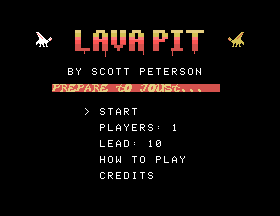 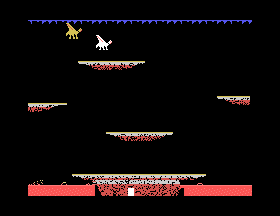 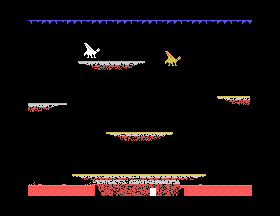 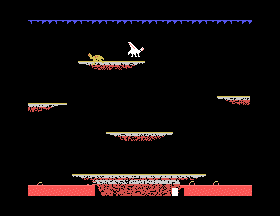 |
|
|
Guide your ship along the grid and collect every diamond. Four guards patrol the edges of the grid and fire energy bolts along the grid lines. A hit costs a ship and fills the board with more diamonds. Clearing the board takes you to a faster level. Diamonds score 10 times the current level, and another ship is awarded every 5,000 points. You start with three ships, and the session high score is kept, as in the original.
The original is one BASIC SYS line followed by about 2 KB of 6502 machine code; its rules and timing were reconstructed from that program, the magazine article and play in a Commodore 64 emulator. Movement stays continuous, with direction changes at intersections, and new tile and sprite art fits the ColecoVision screen. Controls: either joystick. The stick steers the ship at each intersection; a button starts the game and replays it after game over. ColecoVision version by Amy Studio, written in Amy, the language by Amy Bienvenu. From RUN magazine, December 1990, and its ReRUN disk: original Commodore 64 machine-language program by Tony Brantner. This is a modern homebrew adaptation, not a commercial Coleco release. |
Amy Studio/Amy Purple (Bienvenu) | 4kb | 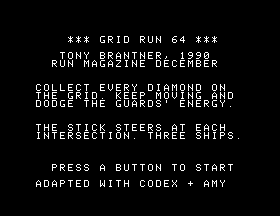 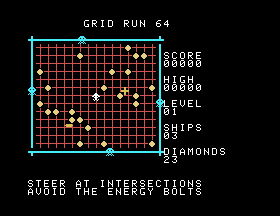 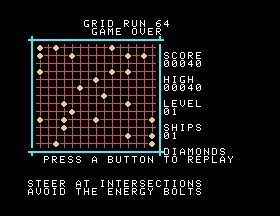 |
|
|
Hostile ships are stealing Earth's water. Your ship hangs over a cloud field that scrolls in eight directions. Gravity pulls you down and the ground is fatal. Flying high (white) you are safe but harmless; flying low (green) you can shoot, refuel and be hit. Shoot three saucers to end a level; their shots sweep toward you, and a saucer is worth the level times the level plus one. Fly low over the F depot to refuel. From level 3 the saucers fly, on levels 3, 7 and so on a gravity ring pulls you, and on levels 4, 8 and so on a red orb roams that you must not meet low. Clearing levels 4, 8 and so on earns a spare ship, up to three.
The rules come from a disassembly of the original machine code and keep its sprite coordinates and pixel collisions; only the drawing is scaled to the ColecoVision screen. The title tune is new. Controls: either controller. Stick left and right turn the ship through 16 headings, up is thrust, down climbs against gravity, and the button fires. ColecoVision version credited in the source to Claude (an AI made by Anthropic) for Amy Studio, in Amy, the language by Amy Bienvenu, 2026: a faithful adaptation of the original program. From RUN magazine's 1989 ReRUN Special Issue: original Commodore 64 machine-language program by Charles Orcutt, with graphics by Dan Diamante. This is a modern homebrew adaptation, not a commercial Coleco release. |
Amy Studio/Amy Purple (Bienvenu) | 21kb | 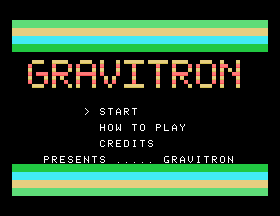  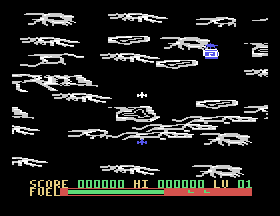  |
|
|
Two gantries face each other across two eroding walls. Each player moves a gantry up and down and fires one shell at a time across the field. A shell that strikes a wall knocks out one block of that row, the block nearest the shooter's side, so a hole can be opened and fired through. A shell that strikes the other gantry damages it, from minor to medium to severe to scrap, and the first gantry reduced to scrap loses. A hit freezes play for the explosion.
In a one-player game you are the left gantry and the computer the right. The LEVEL setting, EASY, NORMAL or HARD, changes only how fast the computer reacts and how well it aims. The speeds of the gantries and shells were traced from the original machine code, and the field is scaled to the ColecoVision screen. The music, Gantry March, was written for this version. Controls: in a two-player game controller 1 is the left gantry and controller 2 the right. The stick moves your gantry up and down and the button fires. On the title, stick left or right picks the level. ColecoVision version credited in the source to Claude (an AI made by Anthropic) for Amy Studio, in Amy, the language by Amy Bienvenu, 2026: a faithful adaptation of the original program. From RUN magazine's September/October 1989 ReRUN disk: original Commodore 64 machine-language program by Colin Adams. This is a modern homebrew adaptation, not a commercial Coleco release. |
Amy Studio/Amy Purple (Bienvenu) | 9kb | 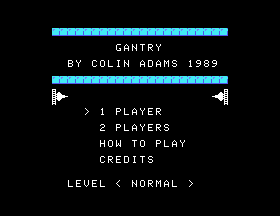 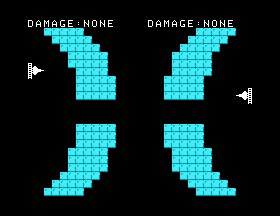 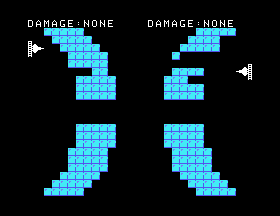 |
|
|
Move your cannon and destroy five rows of animated faces before they reach your base. The formation descends and speeds up as faces are removed. Enemy fire wears away the four shelters, and a hit costs one of your four lives. A passing saucer gives a bonus. Clear every face to begin a faster wave.
The original is a one-line BASIC SYS launcher followed by about 2 KB of machine code; its rules, presentation and pace were reconstructed from that program and play in a Commodore 64 emulator. The ColecoVision version draws the formation of forty faces with tiles, so they stay stable on the console's video chip, with the bullets, cannon and saucer as sprites, and the whole playfield fits the screen. Controls: either joystick. The stick moves the cannon and the button fires; a button starts the game and replays it after game over. ColecoVision version by Amy Studio, written in Amy, the language by Amy Bienvenu. From RUN magazine's November/December 1992 ReRUN disk: original Commodore 64 machine-language program by Reiner Richter. This is a modern homebrew adaptation, not a commercial Coleco release. |
Amy Studio/Amy Purple (Bienvenu) | 4kb | 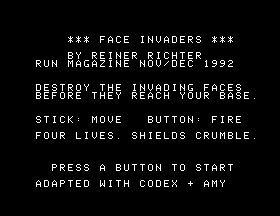 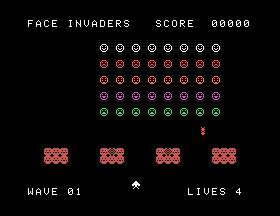 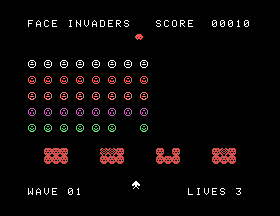 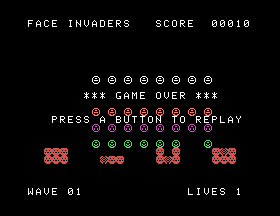 |
|
|
A game of 301 darts for two players. Each starts at 301 and throws three darts a turn. The dart drifts over the board, bouncing off the edges of its range, and you steer it and throw it. The score comes from the original's own table: the sector value, doubled on the outer ring and trebled on the inner ring, with 25 for the green bull and 50 for the red. Go below zero and you are BROKE: that turn's darts do not count. Reach exactly zero to win.
The dart's positions and drift speed are the original's own, traced on the Commodore 64, and the board is drawn from the same scoring table the game uses. The title tune, Oak and Arrow, is new. Controls: the two players share one stick. The stick steers the drifting dart and the button throws it. ColecoVision version credited in the source to Claude (an AI made by Anthropic) for Amy Studio, in Amy, the language by Amy Bienvenu, 2026: a faithful adaptation of the original program. From RUN magazine's May/June/July 1990 ReRUN disk: original Commodore 64 BASIC program by T. Brantner. This is a modern homebrew adaptation, not a commercial Coleco release. |
Amy Studio/Amy Purple (Bienvenu) | 8kb | 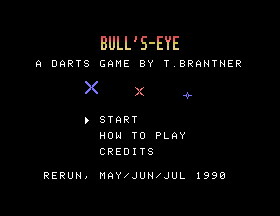 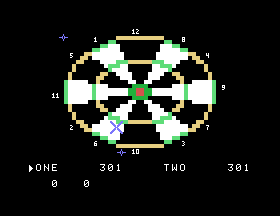 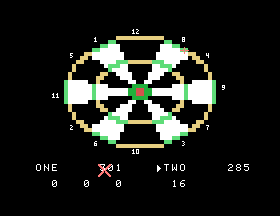 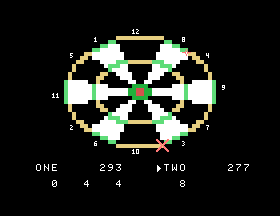 |
|
|
Five time bombs are hidden in a maze of 27 by 17 rooms, dug at random and seen through a scrolling window. Find and touch each bomb to defuse it. When all five are defused the exit lights up, and you must walk out before the three-minute clock runs out. A charge, once picked up, lets you blow away one wall. The level, NOVICE, AMATEUR, EXPERT or MASTER, sets how much of the maze the window shows and how fast it moves: NOVICE sees a lot, MASTER only a little. SAME MAZE plays the last maze again, with blown walls rebuilt, so you can learn it, and the most time left is kept for each level.
The rules and timing were traced from the original's machine code, and the cyan walls and green border are as on the Commodore 64. The music, Cut the Red Wire and Tick Tock, is new. Controls: either controller. The stick moves you through the maze; to blow a wall, hold the button and push the stick against it. ColecoVision version credited in the source to Claude (an AI made by Anthropic) for Amy Studio, in Amy, the language by Amy Bienvenu, 2026: a faithful adaptation of the original program. From RUN magazine's May/June 1991 ReRUN disk: original Commodore 64 machine-language program; the author is not named in the program or the listing. This is a modern homebrew adaptation, not a commercial Coleco release. |
Amy Studio/Amy Purple (Bienvenu) | 11kb | 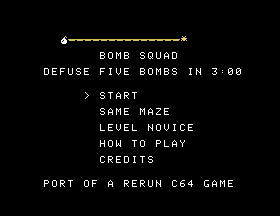 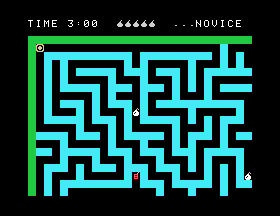 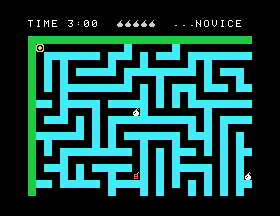 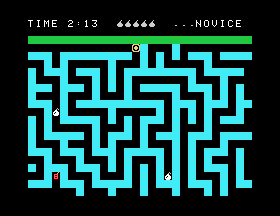 |
|
| 9kb | — |
|||
|
A clown keeps two or three balls in the air, each flying its own arc from hand to hand. You slide both hands together between three positions so that one is waiting under every ball as it falls; miss one and it crashes, ending the game. A catch is worth one point with two balls and ten with three, and a score past 49 or 499 springs a surprise: every ball grows to double length.
Controls: Left and right move the hands; up picks three balls and left two on the menu. ColecoVision version credited in the ROM to Claude (an AI made by Anthropic) for Amy Studio, in Amy, the language by Amy Bienvenu, 2026: a faithful adaptation of the published rules. From COMPUTE! magazine, January 1983, pages 58-67: original program by Doug Ferguson. Published for VIC-20, Atari. This is a modern homebrew adaptation, not a commercial Coleco release. |
Amy Studio/Amy Purple (Bienvenu) | 8kb | 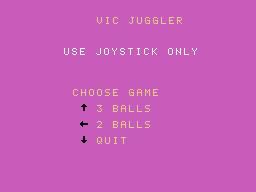 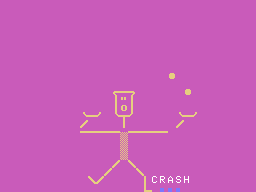 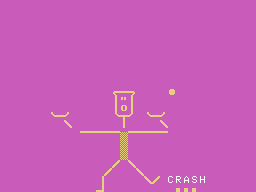 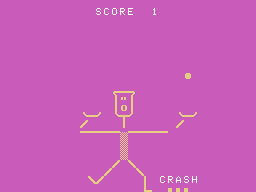 |
|
|
THE HERMIT brings a full 1980s text adventure to the ColecoVision, powered by Amy Studio.
A hermit living in the hills has disappeared, and under his cabin lie abandoned mines, an underground river, a hidden village, a sunken ship, a burial chamber and a spaceship waiting to launch. Find the ten treasures, outwit the bear, the mummy, the black leopard, the demon and the sphinx, bring everything aboard the ship and blast off for a perfect 200 points. No typing and no keypad: every command is chosen from joystick menus showing only what you can see or carry. Every place has its own picture, and the pictures change as you act: push the refrigerator, open the trapdoor, mend the track, hang the rope, open the sarcophagus. Ported from Eric Bryant’s listing in COMPUTE! magazine, November 1987. Details 56 locations, 67 objects, 10 treasures, 29 verbs; the complete original story and puzzles. Nearly 52 KB of text, rules, and graphics packed into a 32 KB cartridge: 9.4 KB of text stored in 5.9 KB with a nested dictionary every rule of the original BASIC game compiled into 1.7 KB of bytecode for a Z80 adventure engine 23 painted location pictures (1,373 tiles) ZX0-packed from 27 KB into 11.6 KB Creatures appear as sprites over the pictures; the leopard and the demon are magnified. Original music, sound effects and a blinking, chiming MORE prompt for long texts. AI disclaimer Entirely done by Claude Opus 5.5 and refined through compilation, emulation and QA gameplay testing. From COMPUTE! magazine, Issue 90, November 1987: original text adventure by Eric Bryant, published for the Commodore 64, IBM PC/PCjr, Apple II series, Amiga and Atari. |
NewColeco/Amy Purple (Bienvenu) | 31kb | 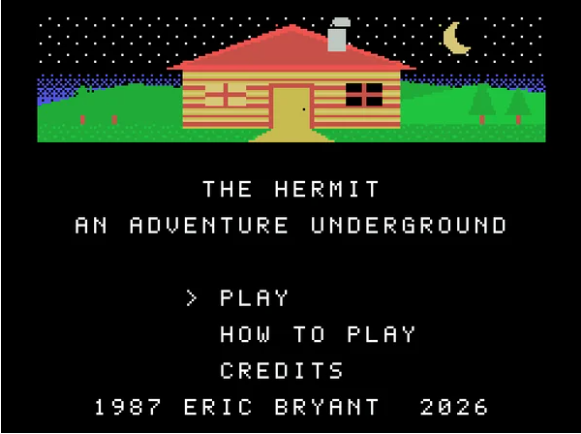 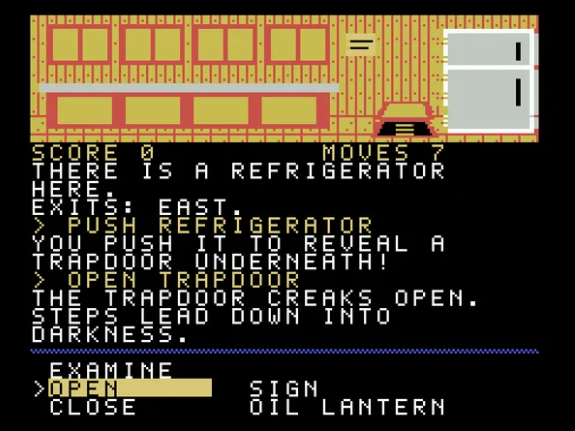 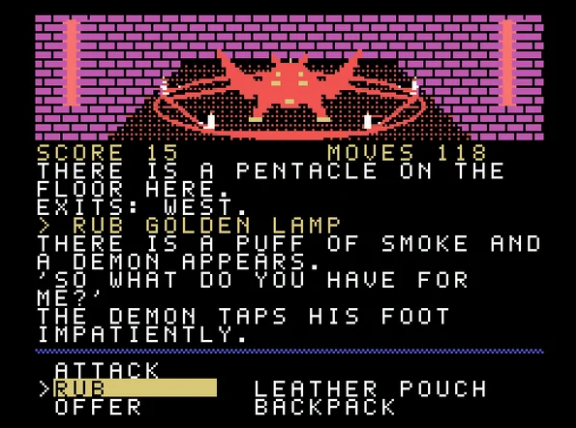 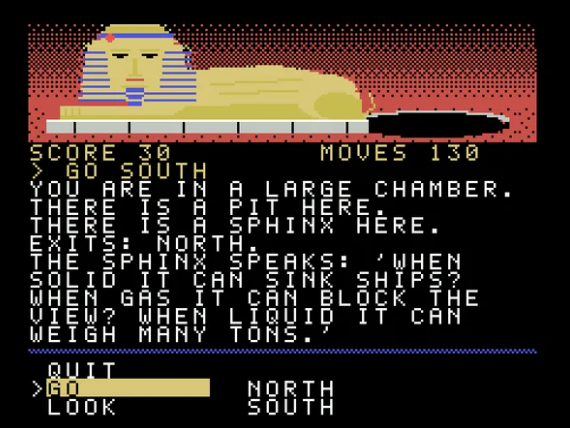 |
|
|
THE HERMIT brings a full 1980s text adventure to the ColecoVision, powered by Amy Studio.
A hermit living in the hills has disappeared, and under his cabin lie abandoned mines, an underground river, a hidden village, a sunken ship, a burial chamber and a spaceship waiting to launch. Find the ten treasures, outwit the bear, the mummy, the black leopard, the demon and the sphinx, bring everything aboard the ship and blast off for a perfect 200 points. No typing and no keypad: every command is chosen from joystick menus showing only what you can see or carry. Every place has its own picture, and the pictures change as you act: push the refrigerator, open the trapdoor, mend the track, hang the rope, open the sarcophagus. Ported from Eric Bryant’s listing in COMPUTE! magazine, November 1987. Details 56 locations, 67 objects, 10 treasures, 29 verbs; the complete original story and puzzles. Nearly 52 KB of text, rules, and graphics packed into a 32 KB cartridge: 9.4 KB of text stored in 5.9 KB with a nested dictionary every rule of the original BASIC game compiled into 1.7 KB of bytecode for a Z80 adventure engine 23 painted location pictures (1,373 tiles) ZX0-packed from 27 KB into 11.6 KB Creatures appear as sprites over the pictures; the leopard and the demon are magnified. Original music, sound effects and a blinking, chiming MORE prompt for long texts. AI disclaimer Entirely done by Claude Opus 5.5 and refined through compilation, emulation and QA gameplay testing. From COMPUTE! magazine, Issue 90, November 1987: original text adventure by Eric Bryant, published for the Commodore 64, IBM PC/PCjr, Apple II series, Amiga and Atari. |
NewColeco/Amy Purple (Bienvenu) | 31kb | 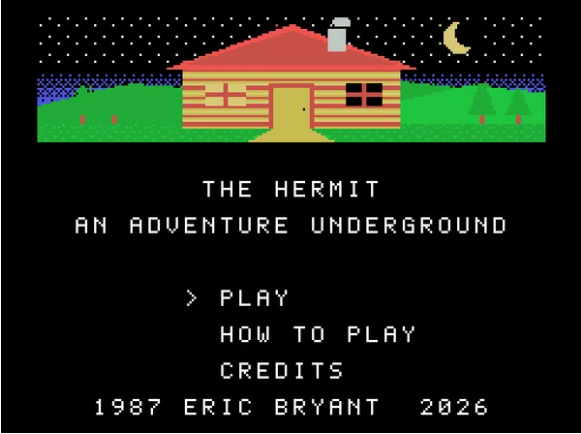 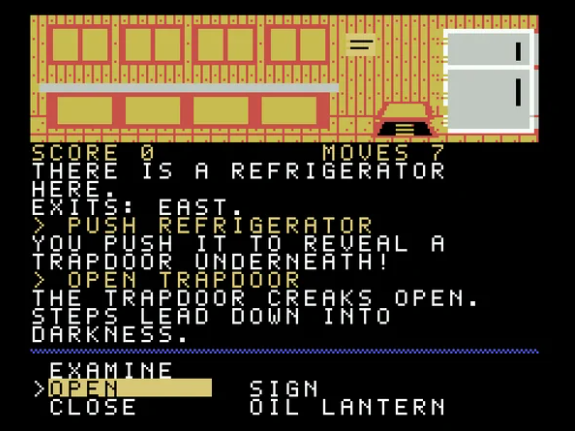 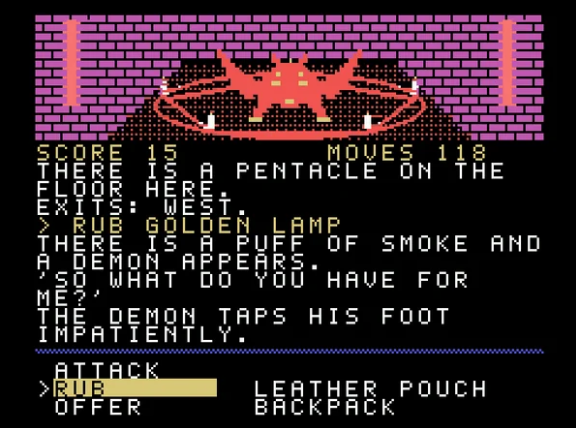 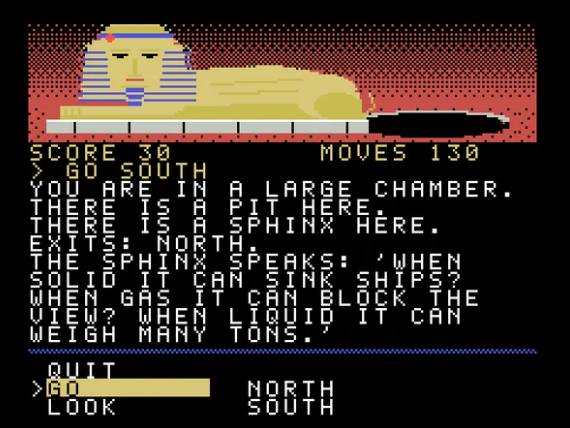 |
|
| 3kb | — |
|||
|
You are the ketchup bottle at the bottom of the screen, and Killer Fries and Psycho Burgers are falling on you. Squirt ketchup up at them: a fry is worth 20 points and a burger 30. Only one drop is in the air at a time, and holding the button fires again automatically. Three fries and two burgers fall at once, and one that gets past the bottom comes back from the top at a new place. A fry or burger touching the bottle costs a life, and you start with four. Shoot the number of burgers shown under TO GO to clear a level: you get an extra life, the next level needs ten more burgers, and everything falls faster.
The rules come from the original's 6502 code and keep its positions and speeds in the original's units, scaled only for drawing. The music is new. Controls: either controller. Stick left and right move the bottle; the button squirts ketchup up. ColecoVision version credited in the source to Claude (an AI made by Anthropic) for Amy Studio, in Amy, the language by Amy Bienvenu, 2026: a faithful adaptation of the original program. From Ahoy!, July 1989, and its ReRUN disk: original Commodore 64 machine-language program by Colin Adams and Brett Kapilik. This is a modern homebrew adaptation, not a commercial Coleco release. |
Amy Studio/Amy Purple (Bienvenu) | 9kb | 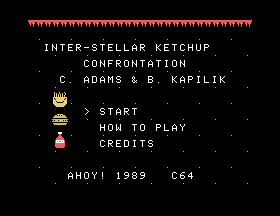 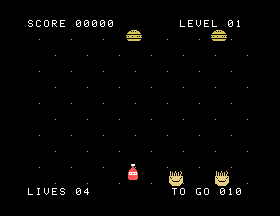 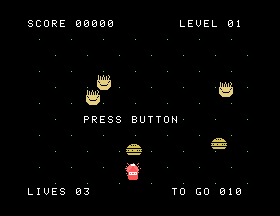 |
|
|
It is 1983, and you are typing in PARACHUTE, a short program by D. Rowe from a worn August 1983 copy of Keyboard Kids (an imaginary magazine; the program was written for this game). Line by line it goes into your listing. Where the page is smudged you must decide what the character was: 1, 7 or I? 0, O or 9? The rest of the line is the clue. Then RUN it, and the little VIC-20 screen above shows what you typed. A wrong guess is a syntax error, or worse, a program that runs but not as printed: a pink sky, a gale, a landing pad off the screen, 70 points a landing. FIX the lines and RUN again.
PARACHUTE itself is simple: a plane crosses the top of the screen, the button drops a parachutist who falls eight rows, drifting with the wind, and a landing on the pad scores. Once it works, change one thing to make it yours: erase the plane's trail (which mends the magazine's own bug in line 50), widen the pad, add gusts of wind or give her a landing sound. The ending tells you how your PARACHUTE came out: lines typed, runs, errors met and landings. The game is not a BASIC interpreter. It plays the program out, and each smudge's three readings have their real effect in VIC-20 BASIC, wraps and all: a diver off the right edge comes back a row lower, and W=I means no wind at all. Controls: either joystick. The stick chooses and the button types or picks. While the program runs, the button is the program's key and pushing the stick down stops it (RUN/STOP). The keypad is not used. An original game by Claude (an AI made by Anthropic) for Amy Studio, written in Amy, the language by Amy Bienvenu, 2026. The idea grew from a morning of porting COMPUTE!'s Gazette type-ins of 1983 with Amy, who typed her first programs on a VIC-20 that year. This is a modern homebrew release, not a commercial Coleco release. |
Amy Studio/Amy Purple (Bienvenu) | 10kb | 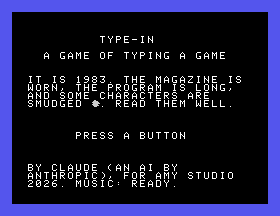 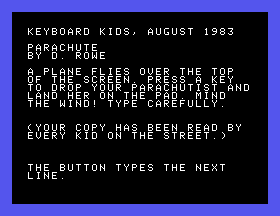 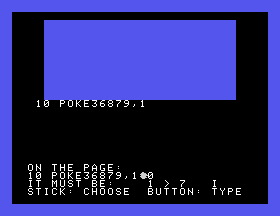 |
|
|
Halloween night. The crows have nested in a stack of crates beyond the field, and you have a slingshot and a pile of jack-o'-lanterns. The camera opens on the crows, pans back to the slingshot, and follows each pumpkin across a field wider than the screen. Glass shatters and lets the pumpkin through; wood cracks, is shoved along, or is broken right through by a hard throw; stone takes a hard throw. A block with nothing under it falls, unless it is held between two blocks or by a neighbour standing on something, and a crow that falls, or that a block lands on, flies off. Now and then one flies straight at the screen.
There are ten stacks. You have three pumpkins for each, four for the last four. Each crow scores 100, a spinning star waiting midway scores 1,000 if a throw hits it, and clearing a stack scores 500 for every pumpkin left. Run out of pumpkins with crows still in the stack and you try that stack again. The field is 80 columns wide and redrawn from the world whenever the camera moves a column. The carved pumpkins glow from inside, and the star's frames were made by turning a real five-pointed star. Controls: either joystick, with two control styles chosen before play. Pinch and pull: hold the button, pull the pouch back with the stick, and let go to throw. Aim and swing: stick up and down aims, holding the button sets the power as it swings up and down, and letting go throws. An original game by Claude (an AI made by Anthropic) for Amy Studio, written in Amy, the language by Amy Bienvenu, 2026, with the camera, the star, the lanterns and the crow at the screen from Amy Bienvenu's ideas, and the music Harvest Moon Jig. This is a modern homebrew release, not a commercial Coleco release. |
Amy Studio/Amy Purple (Bienvenu) | 10kb | 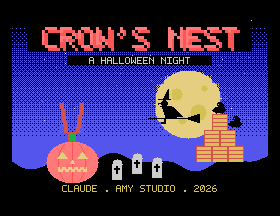 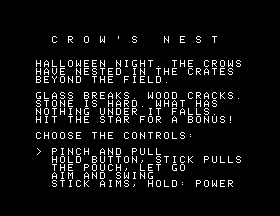  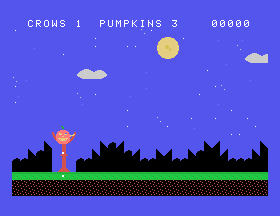 |
|
|
Pip has a little red car and a friend's birthday party to get to before the sun goes down. Drive four legs of country road: the meadow, the pine forest, the lake and the hill. Gifts and flowers lie on the road to pick up. Stumps spin the car and puddles slow it down, the grass is slow, and the bends push the car outwards. The sun is the clock: reach the party before it sets and Pip makes it in time; if not, the party starts without Pip, and the gifts and flowers you collected are counted anyway.
The road is drawn in perspective, scanline by scanline, into a hidden screen page and tile set and then shown at once. The things beside and on the road are sprites drawn at five sizes. Controls: the button is the pedal. The stick steers left and right and brakes when pushed down; tap down in a turn to drift. An original game by Claude (an AI made by Anthropic) for Amy Studio, written in Amy, the language by Amy Bienvenu, 2026: design, program, graphics, sounds and the tune "Evening Drive". This is a modern homebrew release, not a commercial Coleco release. |
Amy Studio/Amy Purple (Bienvenu) | 21kb |  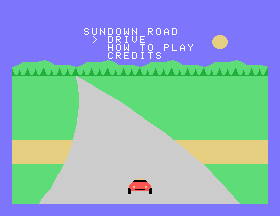 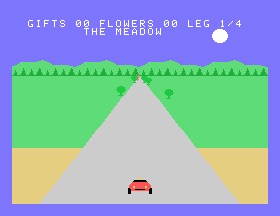 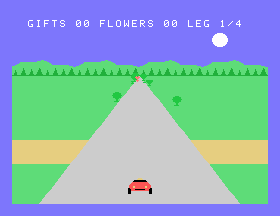 |
|
|
Four logic games from one book chapter, chosen from a menu. In The Pattern Game one player makes a hidden pattern of dots, stars and crosses on a 4 x 4 grid, and a friend reconstructs it, asking for clues when stuck; each clue reveals one square, and the game ends with "YOU DID IT WITH n CLUES". The 3 x 3 and 4 x 4 Number Puzzlers are the old sliding block puzzles: the numbers are shuffled, you move the empty square, and a counter shows how many numbers are already in place. In Dozo, a warm-up game of Japanese Go masters, two sides take turns placing any of four kinds of piece, which belong to nobody, on a triangle of 28 points; the first to complete an equilateral triangle of any size and slant with three identical pieces wins. You play Dozo against the computer, which takes a winning move when it has one and otherwise avoids handing you a triangle.
The rules follow the book's Atari listings line by line. The ColecoVision version puts the three programs on one cartridge with a menu, frames the number blocks, uses joystick menus for the yes/no questions and adds an editorial page. The book's Number Puzzler mix can be impossible to solve, as the chapter itself explains with Sam Loyd's 14-15 Puzzle, so you can choose the book's random mix or a mix made by random slides, which is always solvable, and a message now tells you when the puzzle is solved. The 126 Dozo triangles, which the book lists as 756 DATA bytes, are computed instead. Controls: the joystick moves the cursor. In The Pattern Game, button 1 changes a square's symbol, and button 2 or keypad # finishes the hidden pattern; while guessing, button 2 or keypad * asks for a clue. In the Number Puzzlers the stick slides the empty square, and button 2 or keypad * returns to the menu. In Dozo, button 1 places a piece, button 2 or keypad 1 to 4 changes the piece, and keypad * returns to the menu. ColecoVision version credited in the source to Amy Bienvenu, in Amy, her language, for Amy Studio, 2026: an adaptation of the original programs. From "41 1/2 Fun Projects for the Atari" by Dale Disharoon and Herbert Kohl (Reston Publishing, 1984), Part IV, Strategy Puzzles: original Atari BASIC programs by Dale Disharoon and Herbert Kohl. This is a modern homebrew adaptation, not a commercial Coleco release. |
Amy Studio/Amy Purple (Bienvenu) | 10kb |  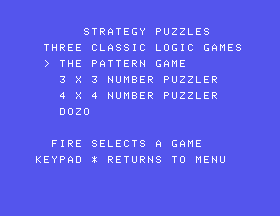 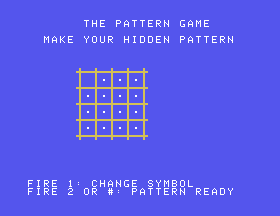 |
|
|
Dusk, and twenty-five stars sleep in the sky. Press a star and it changes, and so do its four neighbours above, below, left and right: a sleeping star wakes, an awake one goes back to sleep. Wake every star and the sky draws a picture, a constellation. There are ten nights, each a little harder, and there is no hurry. The game counts your moves against the fewest possible.
The puzzle is the classic Lights Out kind, made famous by Tiger Electronics in 1995; the stars, the nights, the pictures and the music are new. Each night is made by pressing a few stars of a fully awake sky, so every night can be solved and the fewest moves are known. The introduction is a 120-colour dusk picture. Controls: either joystick. The stick moves between the stars, the left button presses the star you point at and the right button starts the night again. The keypad is not used. An original game by Claude (an AI made by Anthropic) for Amy Studio, written in Amy, the language by Amy Bienvenu, 2026, with the music "Counting Stars at Dusk". This is a modern homebrew release, not a commercial Coleco release. |
Amy Studio/Amy Purple (Bienvenu) | 10kb | 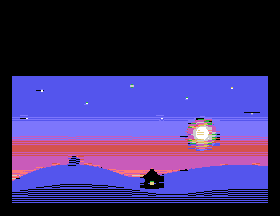 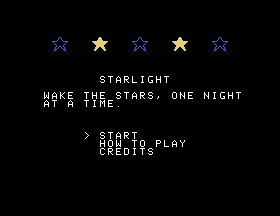 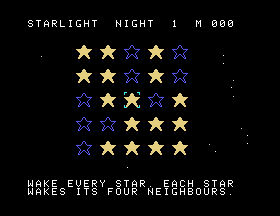 |
|
|
By lamplight, wander the stacks of an old magazine library to find eight lost pages before your lamp runs dry. Each page holds a line of a poem and a little oil. As the oil runs out, the shelves fade into darkness from far to near.
Controls: up walks, down steps back, left and right turn. Hold the button to see a map of where you’ve walked. Finding pages: the lamp tells you how near the nearest lost page is. How it’s drawn: a real ray-cast 3D view at about 20 frames a second, built from 64 tiles rather than a bitmap. That’s a first-person maze with lighting on a 1982 console. |
NewColeco/Amy Purple (Bienvenu) | 20kb | 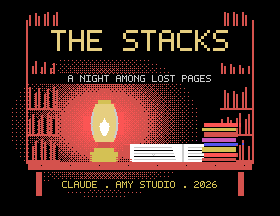 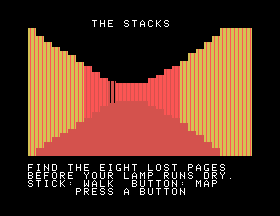 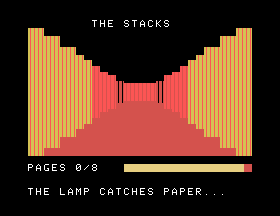  |
|
|
A young bat is lost deep under the hills, too young to know the way, and in the dark it cannot see. It can listen. Press the button to click, and the sound spreads through the open cave, around corners but never through rock, lighting the rock it touches for a moment before it fades back to black. Find the way out of twelve caves; the way out breathes, and shows in its own colours.
Moths glow when a click finds them, and catching all three in a cave earns a life back, up to five. Cave snakes hear your clicks and come to where you made them, and a snake that reaches the bat takes a life; you start with three. Water drips make their own small sounds, and those light the rock too. Flying into rock makes a small bump that shows the wall there, and the caves also hold shaking stalactites, webs, owls and a rushing river. Each click is a flood through open air, one layer of cells a frame, and each click uses one of four tile sets that fades by rewriting only its colours, so the cave glows and darkens smoothly with nothing redrawn. Controls: the stick flies the bat and the button clicks. An original game by Claude (an AI made by Anthropic) for Amy Studio, written in Amy, the language by Amy Bienvenu, 2026, with the music "Under the Hills". The idea of a dark screen lit only where a sound touches was Amy Bienvenu's. This is a modern homebrew release, not a commercial Coleco release. |
Amy Studio/Amy Purple (Bienvenu) | 23kb | 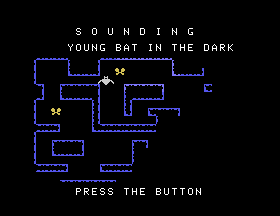 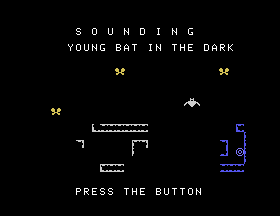 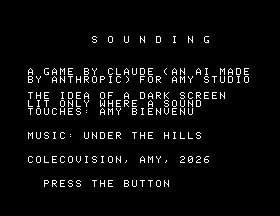 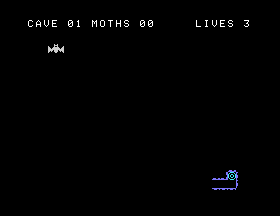 |
|
|
Two snowmen on a snowy hill throw snowballs at each other in turns, through the wind. A snowball that lands digs a hole in the hill, and a snowman with nothing under him slides down into it. Each hit takes some of his snow, and the first to lose all of it loses the round. First to three rounds wins. Play one player against the computer, or two players.
On his turn a snowman can walk up to 40 steps. Besides the plain snowball, each snowman has special throws for the round: two icicles, which drill in and hit hard, one snow bomb, which bounces twice and leaves a big hole, and one gust, which blows the other snowman away. The hill is drawn in the bitmap screen, so every pixel can be dug out and the snowball meets the hill pixel by pixel. Controls: the player whose turn it is, on either joystick. Up and down set the angle, left and right walk, a tap of the button picks the next weapon, and holding the button swings the strength; let go to throw. An original game by Claude (an AI made by Anthropic) for Amy Studio, written in Amy, the language by Amy Bienvenu, 2026: design, program, graphics, sounds and the tune "Snow Day". This is a modern homebrew release, not a commercial Coleco release. |
Amy Studio/Amy Purple (Bienvenu) | 13kb | 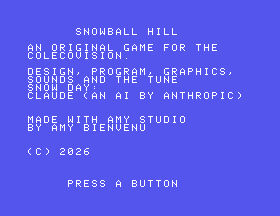 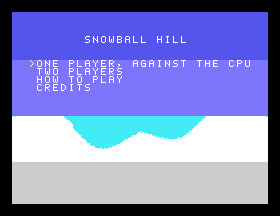 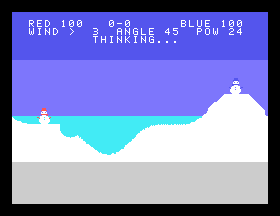 |
|
|
Ski Trails: one long timed run through trees, rocks and skiers cutting across your path.
Slalom: gates against the clock. Each missed gate costs five seconds. Avalanche Run: the story mode. Three stages with the mountain coming down behind you. The slope rises and falls, and what lies beyond each crest stays hidden until you get there. At speed your skis bite less, so you drift wide in a spray of snow. Take a crest fast and you fly, with no steering until you land. Hold fire in the air to cross your skis for a bonus, and let go before you touch down. |
NewColeco/Amy Purple (Bienvenu) | 31kb | 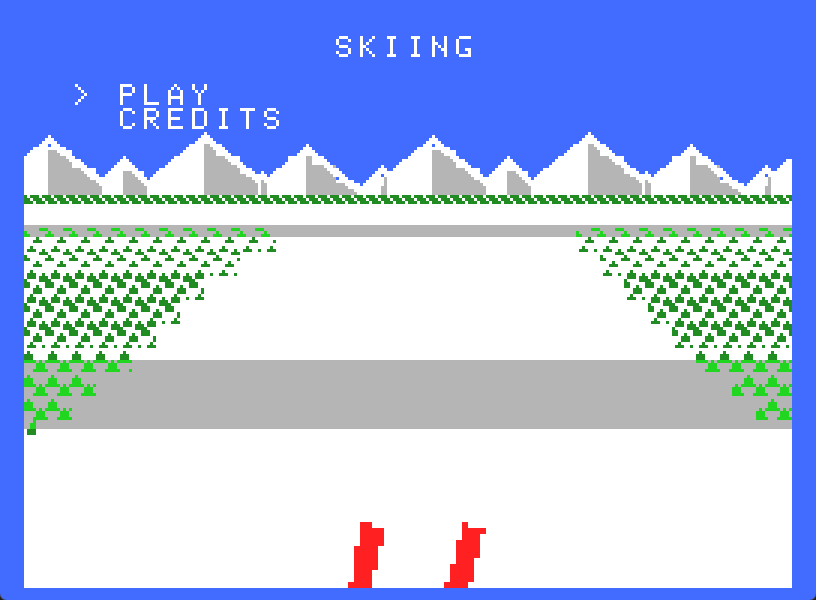 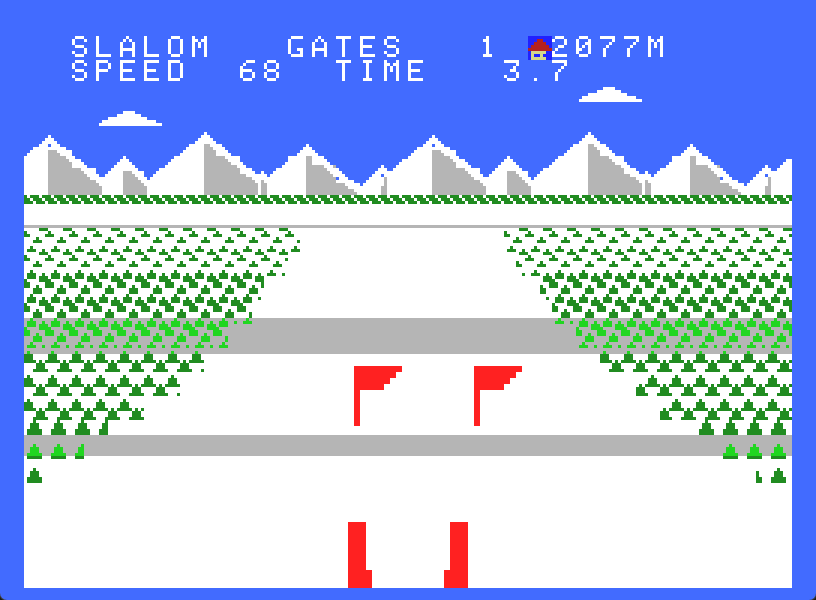 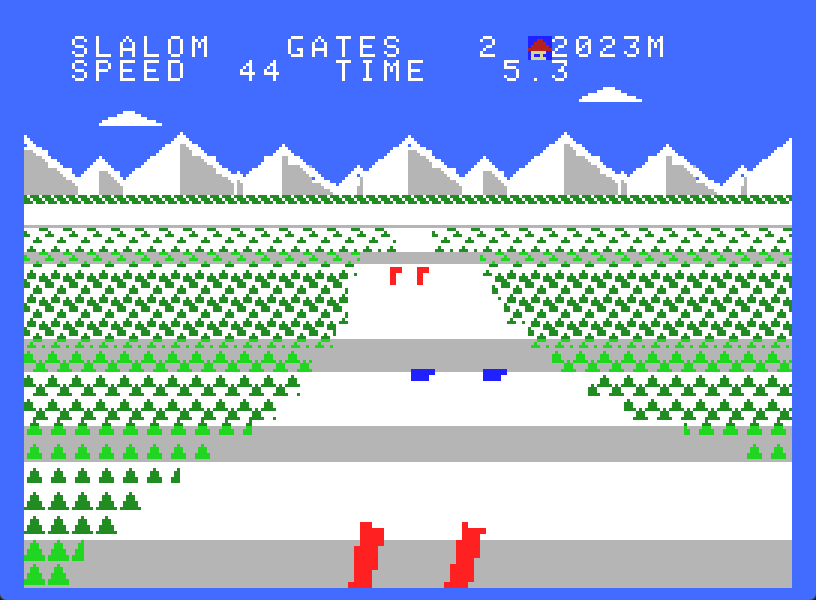 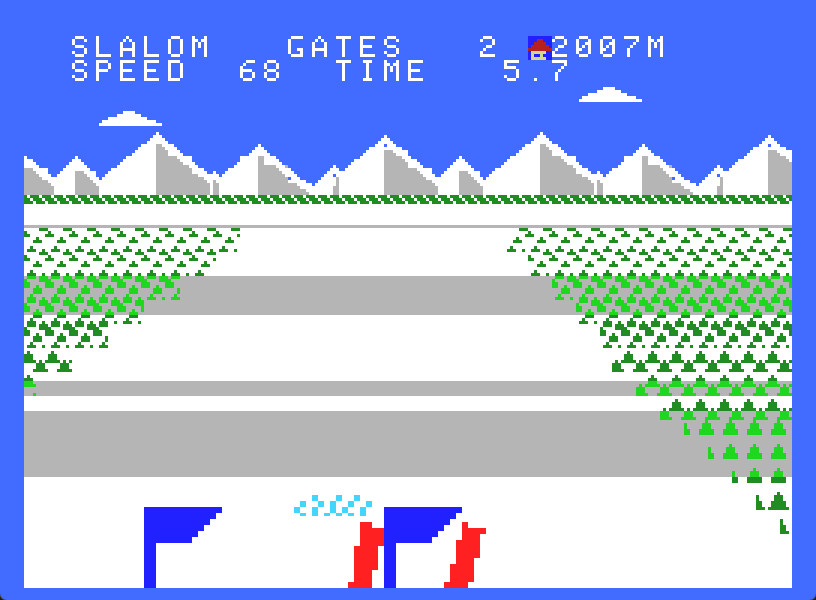 |
|
|
Crows walk the farm road to the barn, and each one that gets in takes corn. Put guards on the stubble beside the road to frighten them away. The scarecrow scares and slows every crow near it, the clapper gives a loud clack now and then that carries far, and the owl stares down the crow closest to the barn. A frightened crow flies off and leaves seeds, and seeds buy guards (20, 35 and 50) and improve them, each up to two times; a guard can also be sold. There are three fields of eight waves each. Keep the corn and the field is saved; lose it all and the crows feast.
Controls: the stick moves the frame. The button on stubble builds a guard; the button on a guard offers to improve or sell it, where left and right choose, the button says yes and up or down says no. The button on the road brings the next wave at once. An original game by Claude (an AI made by Anthropic) for Amy Studio, written in Amy, the language by Amy Bienvenu, 2026: design, program, graphics, sounds and the tune "The Scarecrow's Jig". This is a modern homebrew release, not a commercial Coleco release. |
Amy Studio/Amy Purple (Bienvenu) | 15kb | 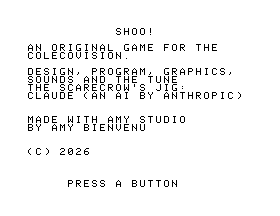 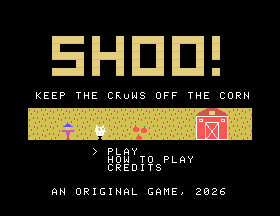 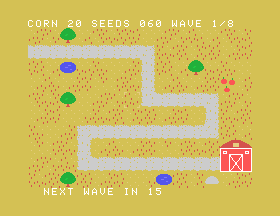 |
|
|
Seedlings drop from the seed box and walk straight ahead, whatever is in front of them. They turn at walls, climb a single step and fall down holes; water drowns them, and a fall of more than six cells is too much. Give them jobs to bring enough of them to the sunny door before time runs out. DIG goes straight down through earth but not rock, STOP stands still and turns the others back, and STEP lays five bricks of stairs ahead; a stopper can still be given a dig or a step. REDO tries the garden again. There are eight gardens.
The garden lives in the screen's name table itself, which the game's machine-code routine reads and writes as the seedlings walk. Controls: the stick moves the pointer. The button on a job in the bottom row picks it, and the button on a seedling gives it that job. An original game by Claude (an AI made by Anthropic) for Amy Studio, written in Amy, the language by Amy Bienvenu, 2026: design, program, graphics, sounds and the tune "Sprout Song". This is a modern homebrew release, not a commercial Coleco release. |
Amy Studio/Amy Purple (Bienvenu) | 14kb |  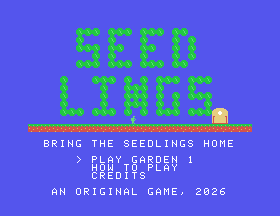 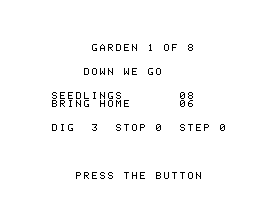 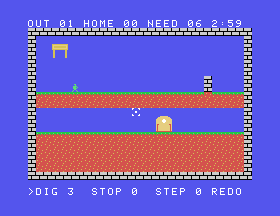 |
|
|
A Christmas game in five stages, played round after round, each round harder. In the Delivery, fly Santa's sleigh over five houses and drop a gift down every chimney before the gifts run out; dead centre is worth a bonus gift. In the Toy Factory, toys drop from three hoppers onto a conveyor belt that slowly drags Santa along: catch them in his sack and dodge the coal, and six misses lose the stage. In Coal Goblins, the goblins march in formation and drop lumps of coal while Santa throws snowballs from behind three igloos, which chip away as they are hit; a flying fruitcake crosses the top for a bonus. In the Ice Wall, the sleigh is the paddle: bounce a snowball into a wall of wrapped gifts and ice blocks and catch the gifts that fall. In the Sky Dash, fly the sleigh through a sky of planes, balloons and birds and grab floating gifts until the distance bar is full.
Santa has three lives, with an extra one after every round. From round 2 the wind pushes the falling gifts and crows cross the sky and take any gift they touch, and the ice wall's top row is ice. Santa's rank rises with every round, from Elf to Father Christmas, and high scores are kept with your initials. The music is "Jingle Bells" (public domain) and tunes written for the game. Controls: either joystick. The stick moves and the button acts: it drops a gift, gives Santa a quick rush in the factory and throws a snowball. In the Sky Dash the stick moves the sleigh up, down, left and right. An original game by Amy Studio, written in Amy, the language by Amy Bienvenu, 2026. This is a modern homebrew release, not a commercial Coleco release. |
NewColeco/Amy Purple (Bienvenu) | 30kb |  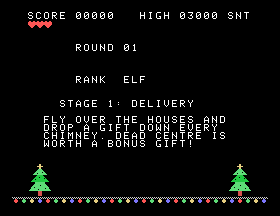 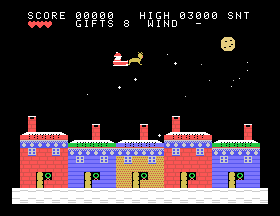 |
|
|
A Christmas game in five stages, played round after round, each round harder. In the Delivery, fly Santa's sleigh over five houses and drop a gift down every chimney before the gifts run out; dead centre is worth a bonus gift. In the Toy Factory, toys drop from three hoppers onto a conveyor belt that slowly drags Santa along: catch them in his sack and dodge the coal, and six misses lose the stage. In Coal Goblins, the goblins march in formation and drop lumps of coal while Santa throws snowballs from behind three igloos, which chip away as they are hit; a flying fruitcake crosses the top for a bonus. In the Ice Wall, the sleigh is the paddle: bounce a snowball into a wall of wrapped gifts and ice blocks and catch the gifts that fall. In the Sky Dash, fly the sleigh through a sky of planes, balloons and birds and grab floating gifts until the distance bar is full.
Santa has three lives, with an extra one after every round. From round 2 the wind pushes the falling gifts and crows cross the sky and take any gift they touch, and the ice wall's top row is ice. Santa's rank rises with every round, from Elf to Father Christmas, and high scores are kept with your initials. The music is "Jingle Bells" (public domain) and tunes written for the game. Controls: either joystick. The stick moves and the button acts: it drops a gift, gives Santa a quick rush in the factory and throws a snowball. In the Sky Dash the stick moves the sleigh up, down, left and right. An original game by Amy Studio, written in Amy, the language by Amy Bienvenu, 2026. This is a modern homebrew release, not a commercial Coleco release. |
NewColeco/Amy Purple (Bienvenu) | 9kb | 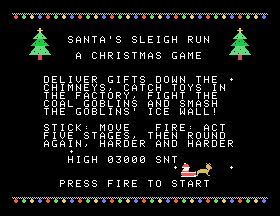 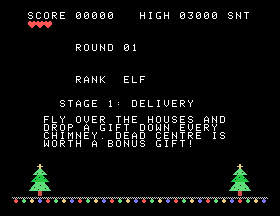 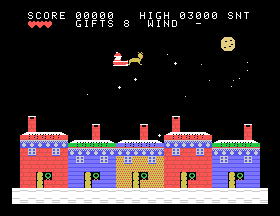 |
|
|
Trains come out of the tunnels one after another, each painted the colour of the station it must reach: red, blue or yellow. They follow the track by themselves; you set the points, the switches drawn in white, where the way they are set is joined and the other way shows only a stub. A train that runs through points from a branch side goes on along the stem. A train at the wrong station, back in a tunnel or in a crash is a wreck, and three wrecks close the yard. The bottom row shows the next train to come. There are eight yards, each busier than the last.
Controls: the stick moves the pointer, and the button on a set of points sets them the other way. An original game by Claude (an AI made by Anthropic) for Amy Studio, written in Amy, the language by Amy Bienvenu, 2026: design, program, graphics, sounds and the tune "Down the Line". This is a modern homebrew release, not a commercial Coleco release. |
Amy Studio/Amy Purple (Bienvenu) | 13kb | 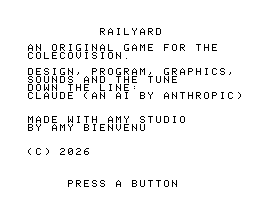 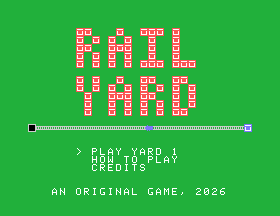 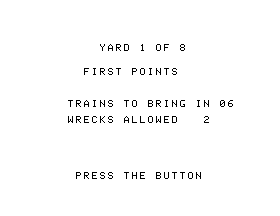 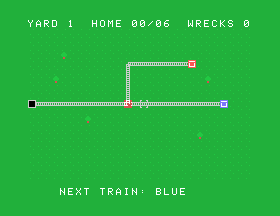 |
|
|
Pip the fox turns ten, and her woodland friends throw her a party under the old willow: an owl, a hedgehog, a raccoon, a bunny and a bear cub. Go from game to game across the party map. Every game won is a present, and every present is a candle on the cake at the end.
There are eight minigames. In Treasure Hunt, dig for the party favours the raccoon buried; the beeps get higher as you get closer. In Hide and Seek, four friends hide behind the furniture: listen for giggles and look for the bunny's ears. In Balloon Pop, throw acorns at the owl's balloons, but never the colour the owl hoots, which changes. In Musical Chairs, walk round while the tune plays and run to a mushroom stool when it stops, with one stool fewer every round. In Pin the Tail, see where the bear's tail goes, then pin it blindfolded by the hot and cold hints, with three tries. In Pass the Parcel, grab it first when the music stops, but pressing too early fumbles; there are five layers. In the Sack Race, hop only once you have landed, or Pip trips, and beat the bunny, hedgehog and bear. In Fireflies at Dusk, catch ten fireflies while they glow. The finale is the cake, one candle per present (at least one), blown out to "Happy Birthday". Controls: either joystick. The stick moves Pip, and either button digs, searches, throws or blows. The keypad is not used. An original game by Amy Bienvenu for Amy Studio, written in Amy, her language, 2026. The birthday song comes from the 2006 ColecoVision 10-years cake demo (now the 1996-2026 anniversary demo in Amy Studio, by Amy Bienvenu); the song itself is in the public domain. A tribute to the party games of the ColecoVision. This is a modern homebrew release, not a commercial Coleco release. |
NewColeco/Amy Purple (Bienvenu) | 23kb | 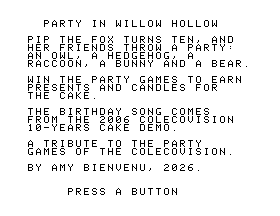 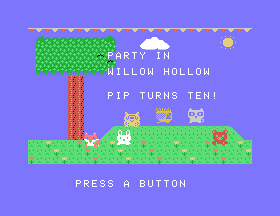 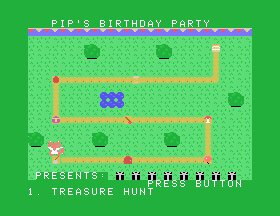 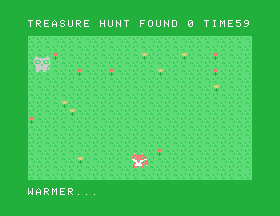 |
|
|
Before The Oregon Trail became the famous 1985 game, MECC’s Apple II classrooms had OREGON: a family of five, $700, and 2,040 miles from Independence to Oregon City in 1847.
You buy oxen, food, bullets, clothing and supplies. Then, two weeks at a time, you hunt, stop at forts, decide how well to eat, meet riders, and cross the mountains before the snow. This is a line-by-line port of the 1980 program, taken from the original disk. It has MECC’s own map, wagon, deer, riders and wolves, drawn just as the Apple drew them. It plays “Sweet Betsy from Pike” from the program’s own data, and keeps every message, every odd rule and every way to die. On the ColecoVision it’s joystick only, with no typing: you set amounts with the stick and press the button to shoot. Made with Amy Studio, with a manual and box art. Not affiliated with MECC or its successors. |
NewColeco/Amy Purple (Bienvenu) | 30kb | 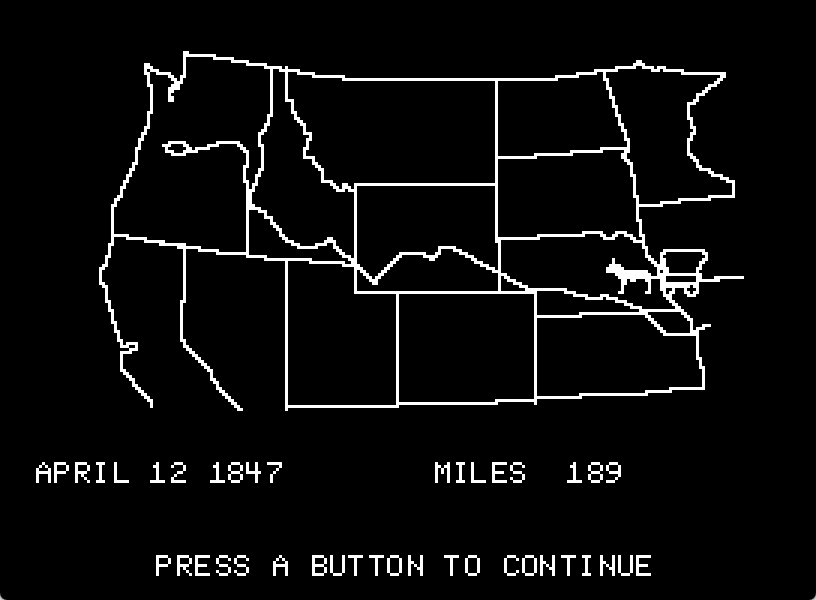 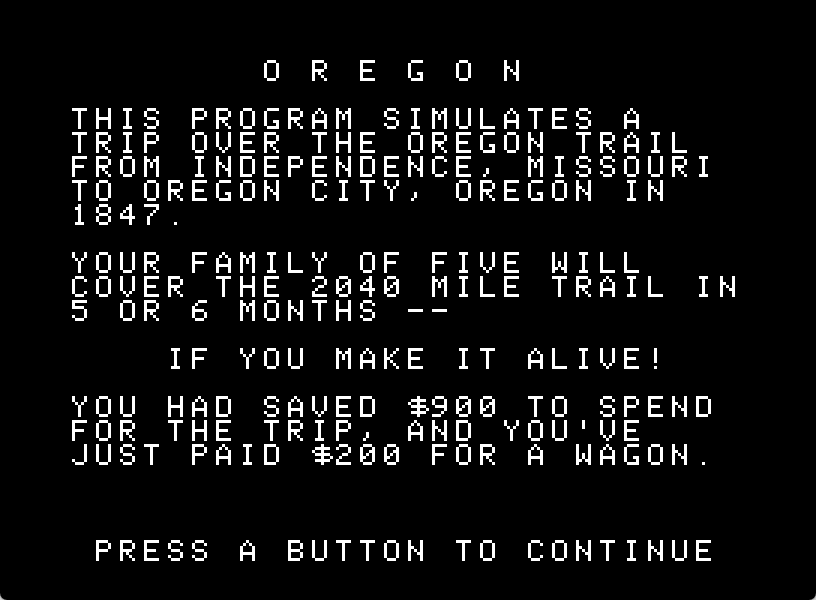 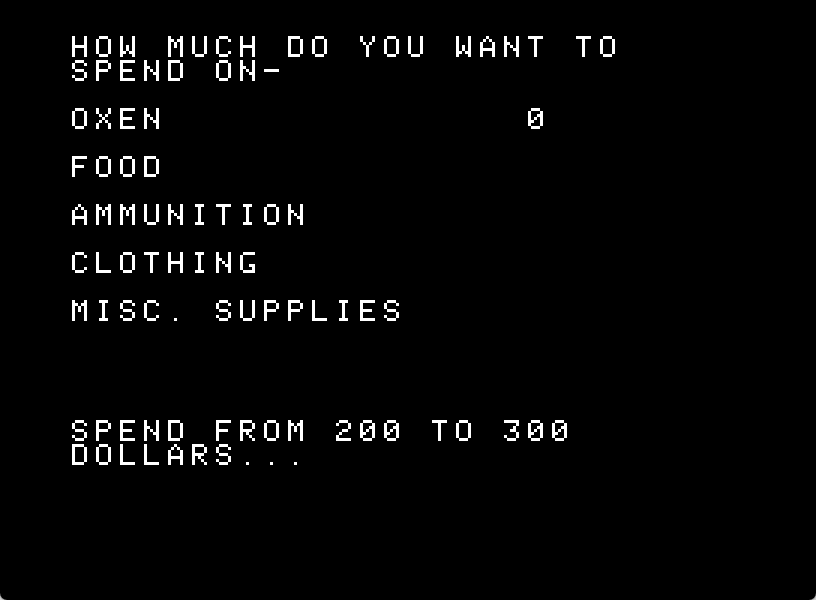 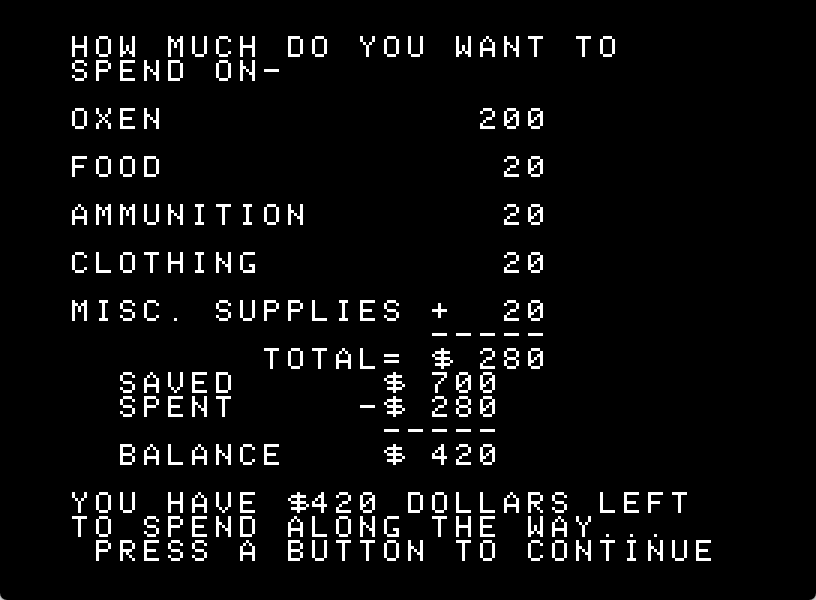 |
|
|
Fly through the sectors of a spiral galaxy, over alien planets and through open space, in a fast into-the-screen shooter inspired by the Star Fox games, running at a near-steady 60 frames a second.
Controls: the stick flies your ship, the left button fires and the right button does a barrel roll. During the roll you’re safe from everything. Enemies: fighter squadrons, rocks and gunners. Pick-ups can upgrade your blaster or repair you. Bosses: the Mothership, whose hangar door shields its core, and, at the spiral’s end, the Maelstrom’s Eye with its circling guards. Music: original music throughout. A jukebox cartridge, NOVA RUN JUKEBOX, plays every tune on its own. Tip: you can only hit a boss’s core when your ship lines up with it. |
NewColeco/Amy Purple (Bienvenu) | 31kb | 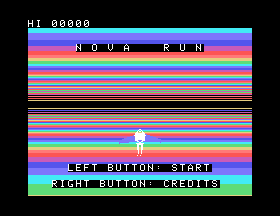 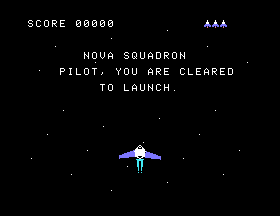 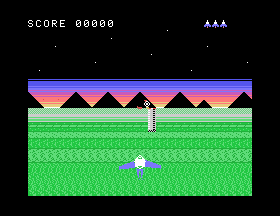 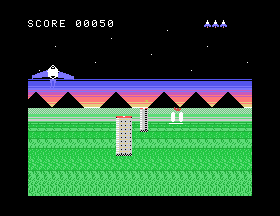 |
|
|
The museum is closed and the galleries are dark. Somewhere in the building a thief is cutting priceless paintings from their frames, and you are the only guard on duty.
Night Rounds is a first-person stealth game about listening, not shooting. The thief's footsteps grow louder as you close in, and quicker and sharper when he breaks into a run; while he works on a canvas you can hear the faint hiss of his knife. Your flashlight shows him from across a room, but he sees the beam too and will bolt, and in the dark he is only a grey shape a few steps away. Follow the sound, choose your moment, then rush him. Every painting he takes leaves an empty frame on the wall. Hold out until dawn with fewer than four stolen and the night is yours; catch him and it is a triumph. If he gets away with four paintings, the game is over. Each night brings a bigger museum, a faster thief and fewer spare batteries, across three museums, and the thief is never in the same place twice. The spiritual sequel to The Stacks, built on the same engine: ray-cast first-person galleries at about 18 views a second on a plain 32K cartridge, the engine's first textured walls (the paintings), a thief drawn by distance and hidden correctly behind walls, and positional footstep sounds at the heart of the play. A noir title screen and original music: "Moon Over the East Wing" and "Empty Halls". Controls: joystick only; no keypad overlay is needed. Runs on the standard ColecoVision BIOS. An original game by Claude (an AI made by Anthropic) for Amy Studio, written in Amy, the language by Amy Bienvenu, 2026. This is a modern homebrew release, not a commercial Coleco release. |
Amy Studio/Amy Purple (Bienvenu) | 29kb | 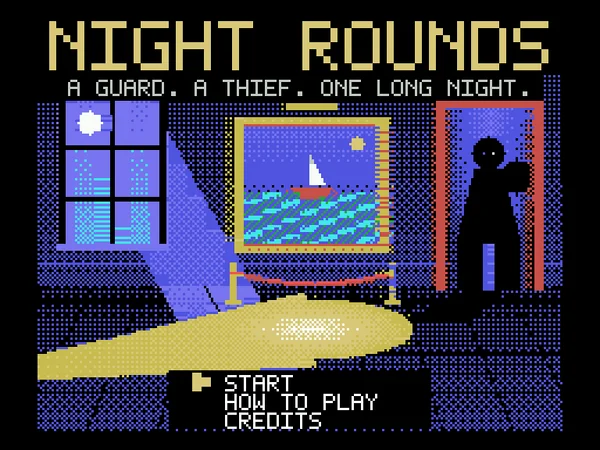 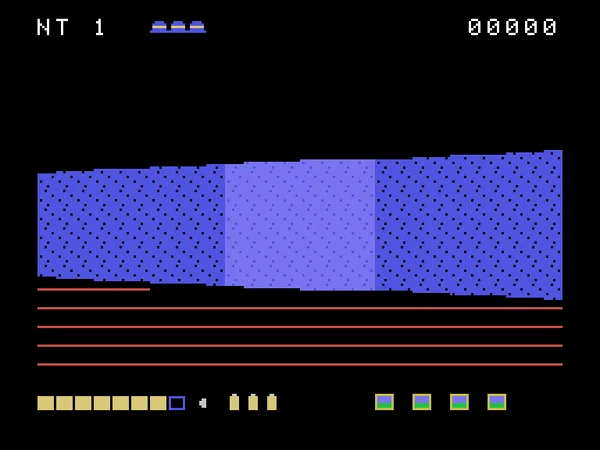 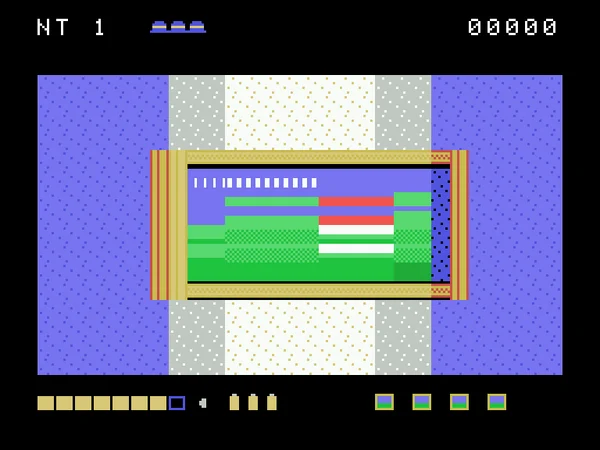 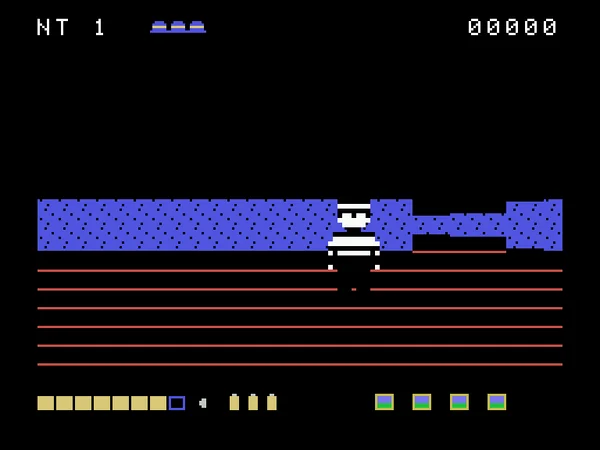 |
|
|
A short demonstration of how an Amy project can be split into separate source files, each owning one part of a program. The title menu offers three screens, each from its own file: Space Navigation (a ship's status: sector, fuel, cargo and a locked course), Rescue Encounter (a dark station, a signal below, and the objective of finding the crew and returning to the ship) and Device Console (the services the program expects: video ready; keyboard, storage and network marked for a future ADAM build). A fourth file holds small self-tests of the language's arithmetic, shown on the menu when the test build is made.
It is not a playable adventure: each screen is a fixed page. The project is meant for an eventual native ADAM version and for now builds as a ColecoVision cartridge. Controls: the keypad keys 1 to 3 choose a screen; a button press returns to the menu. A demonstration program from Amy Studio, written in Amy, the language by Amy Bienvenu, 2026. This is a modern homebrew release, not a commercial Coleco release. |
NewColeco/Amy Purple (Bienvenu) | 1kb | 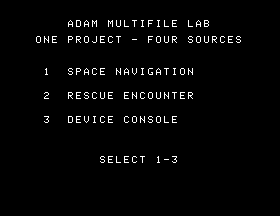 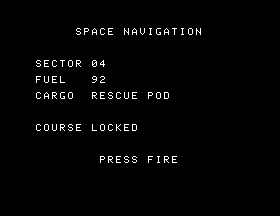 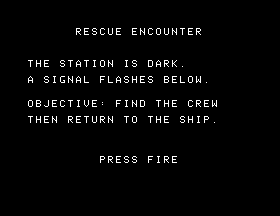 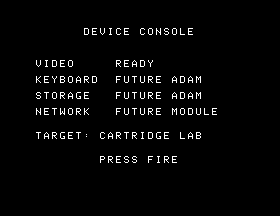 |
|
|
A flock of Canada geese flies south for the winter in four legs: the north bay, the great lakes, the ridges and the marsh. You are the lead goose, and the others follow in a V, each flying where the one ahead flew a moment before, so the V bends and flows behind every turn. The flock gets hungry as it flies, twice as fast over the mountains. Hold the button over a lake to come down and feed while the land stops moving, but every moment on the water lets the frost come closer, and a flock caught by the frost loses its last goose.
Storm clouds scatter geese out of the V, a hawk comes for the goose at the back unless the lead flies at it, and a goose left without food drops out. Lost geese wait on the ground below: fly over one and it joins the V again. The end of the journey counts the geese that flew the whole way south. Controls: the stick steers the lead goose; hold the button over a lake to come down and feed. An original game by Claude (an AI made by Anthropic) for Amy Studio, written in Amy, the language by Amy Bienvenu, 2026, with the music "Southward". This is a modern homebrew release, not a commercial Coleco release. |
Amy Studio/Amy Purple (Bienvenu) | 15kb | 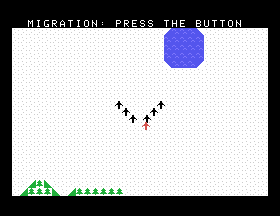 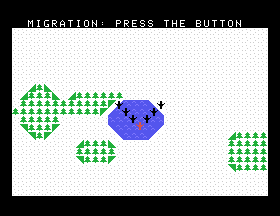  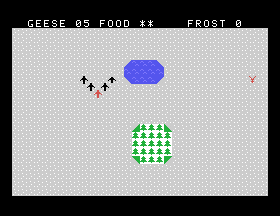 |
|
|
Lay roads, mark lots for homes, shops and works, and put up parks and power plants. A lot grows through three sizes when it has a road beside it, power from a plant within 7 cells, and demand: homes want jobs, and works and shops want people. Works near homes keep them small, and a park nearby lets them grow into flats. Every month brings taxes in and costs upkeep, and the pointer shows what a lot lacks or what the town wants. The town becomes a village, then a town, and at 600 people a city.
The town is kept in the screen's name table itself, one tile per cell, and a machine-code routine reads and writes it. Controls: the stick moves the pointer and the button builds; hold it to lay a line of road. Pick a tool (road, home, shop, work, park, power or clear) on the bottom row. An original game by Claude (an AI made by Anthropic) for Amy Studio, written in Amy, the language by Amy Bienvenu, 2026: design, program, graphics, sounds and the tune "Main Street". This is a modern homebrew release, not a commercial Coleco release. |
Amy Studio/Amy Purple (Bienvenu) | 10kb |  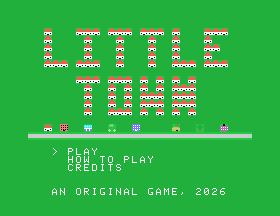 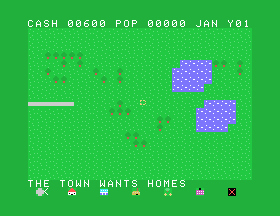 |
|
|
You keep the light on Gull Point through five stormy nights. The lamp turns by clockwork, and the clockwork runs down, faster on each later night: turn the stick round and round, clockwise, to wind it and keep the beam sweeping. Ships come in from the dark sea making for the harbour under the cliff. A ship knows where it is only while the beam has swept over it lately; one left in the dark too long loses its way, drifts, and can end on the reefs.
Each night brings more ships, and from the fourth they come faster. From the third night fog banks roll in: the light cannot reach a ship in the fog, but you can hear its horn, and the lighthouse's own horn answers and guides every ship in the fog. At dawn the ships still at sea are safe. Three wrecks and the light has failed; keep it through all five nights to see the storm pass. The beam is drawn without sprites: its 97 rays over the sea were worked out once, and every frame the old beam's cells get their scene tiles back while the new beam's cells get lit copies, so there is no flicker. Controls: either joystick. Turn the stick round clockwise to wind the lamp; the button sounds the horn. An original game by Claude (an AI made by Anthropic) for Amy Studio and Amy Bienvenu, written in Amy, the language by Amy Bienvenu, 2026, with the music The Keeper's Waltz. This is a modern homebrew release, not a commercial Coleco release. |
Amy Studio/Amy Purple (Bienvenu) | 10kb | 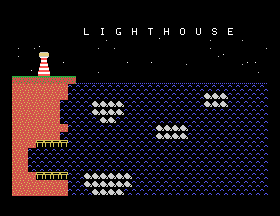 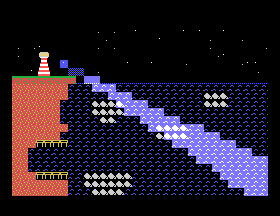 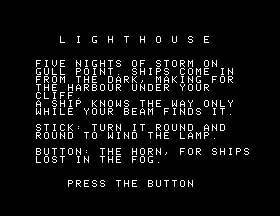  |
|
|
You keep the light on Gull Point through five stormy nights. The lamp turns by clockwork, and the clockwork runs down, faster on each later night: turn the stick round and round, clockwise, to wind it and keep the beam sweeping. Ships come in from the dark sea making for the harbour under the cliff. A ship knows where it is only while the beam has swept over it lately; one left in the dark too long loses its way, drifts, and can end on the reefs.
Each night brings more ships, and from the fourth they come faster. From the third night fog banks roll in: the light cannot reach a ship in the fog, but you can hear its horn, and the lighthouse's own horn answers and guides every ship in the fog. At dawn the ships still at sea are safe. Three wrecks and the light has failed; keep it through all five nights to see the storm pass. The beam is drawn without sprites: its 97 rays over the sea were worked out once, and every frame the old beam's cells get their scene tiles back while the new beam's cells get lit copies, so there is no flicker. Controls: either joystick. Turn the stick round clockwise to wind the lamp; the button sounds the horn. An original game by Claude (an AI made by Anthropic) for Amy Studio and Amy Bienvenu, written in Amy, the language by Amy Bienvenu, 2026, with the music The Keeper's Waltz. This is a modern homebrew release, not a commercial Coleco release. |
Amy Studio/Amy Purple (Bienvenu) | 11kb | 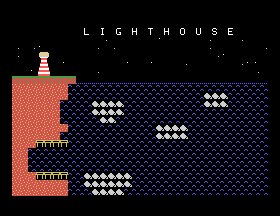 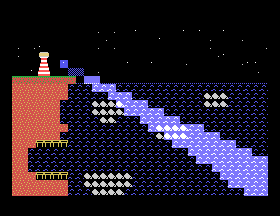 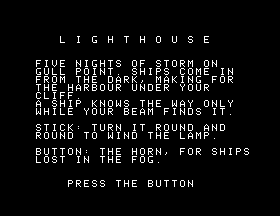  |
|
|
Run a lemonade stand in Lemonsville. Each morning brings the weather report; then, for each stand, decide how many glasses of lemonade to make, how many advertising signs to buy and what price to charge, and see the day's report. Hot days sell more and cloudy ones less, a thunderstorm ruins everything, and the street department may close your street for the day. From one to thirty stands can play, taking turns.
The ColecoVision version keeps the program's own arithmetic: it runs Applesoft's floating-point routines translated to the Z80, so every sale, every cent and every random number comes out as on the Apple, rounding and all. The weather follows Applesoft's random numbers from the same starting seed, so the same answers bring the same weather. The listing's quirks are kept too: the street crews never buy lemonade, bankrupt stands keep their last answers, and with one player, going bankrupt still ends the program with the original's error message. The text is rewrapped for the narrower screen, the low-resolution pictures are the Apple's own, amounts are set with the joystick instead of typed, and the title tune is the listing's. Controls: either joystick. An amount is set with the stick (up and down by 1, right and left by 10, held for faster) and entered with the left button; a choice is made with the stick and the left button. Where the original asked for RETURN to continue or ESC to end, the left button goes on and the right button ends. The keypad is not used. ColecoVision version credited in the source to Claude (an AI made by Anthropic) for Amy Studio, in Amy, the language by Amy Bienvenu, 2026: a faithful adaptation of the original program. From the Apple II DOS 3.3 System Master: original Apple II BASIC (Applesoft) program, copyright 1979 Apple Computer Inc., after Bob Jamison's 1973 game for the Minnesota Educational Computing Consortium (MECC). This is a modern homebrew adaptation, not a commercial Coleco release. |
Amy Studio/Amy Purple (Bienvenu) | 18kb | 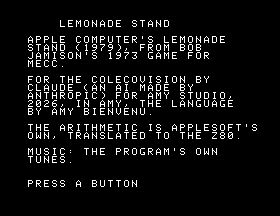   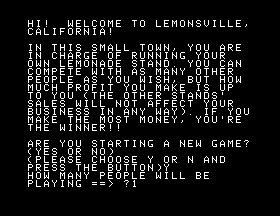 |
|
|
Lamplighter is a quiet game. The town has gone dark, and Ada, the old lamplighter, has handed you her pole. You walk ten districts from her cottage to the top of the hill and light 33 lamps by hand. There are no enemies, no timer and no lives. Each lamp warms the street around it: the bricks turn red, the windows glow and the water sparkles. Each lamp also leaves a small story behind.
An original waltz, plus a short tune for each quarter of town you bring back to light 17 small secrets, most of them acts of kindness: a cat to befriend, a flickering sign to fix, a stopped tower clock to mend if you find the right book in the library A tower clock whose hands are a sprite redrawn as the minutes pass A synthesized “thank you” at the end, in a voice that is a little robotic but sincere 32K, no bank switching, joystick only |
NewColeco/Amy Purple (Bienvenu) | 28kb | 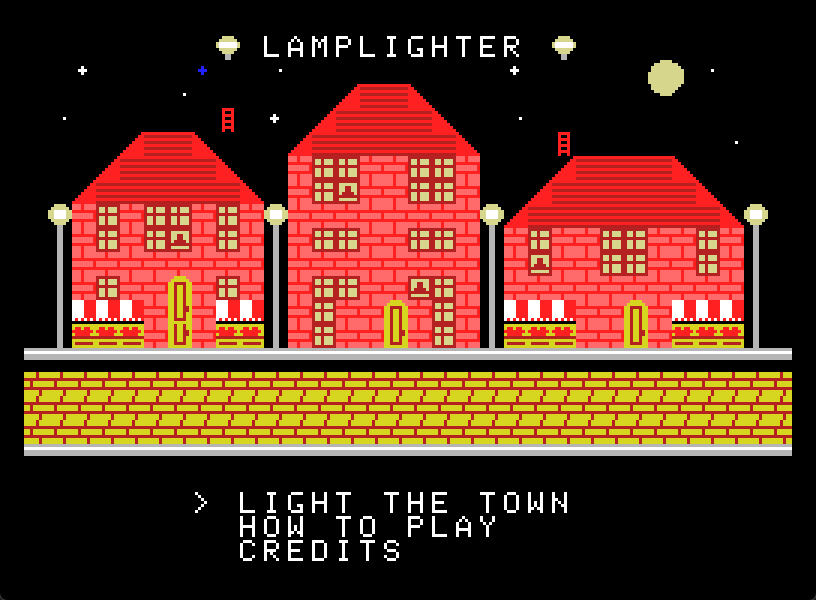 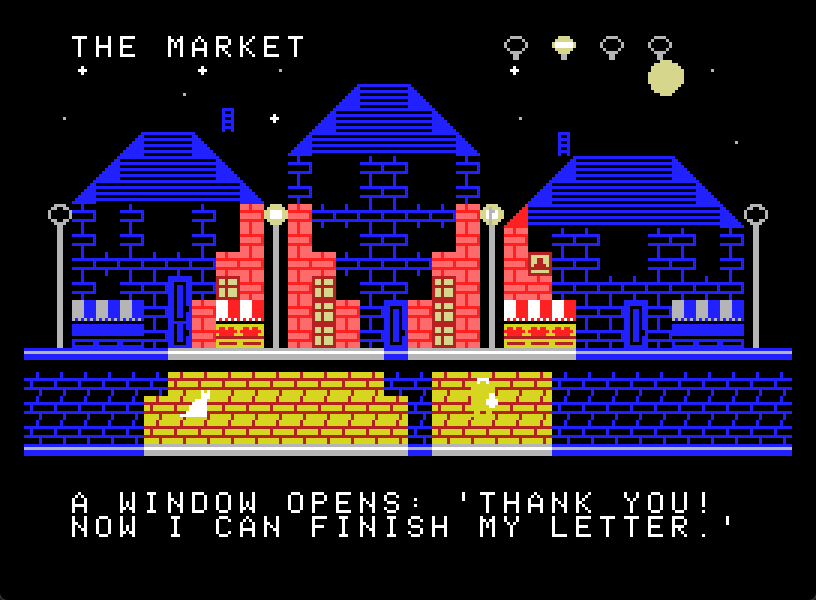 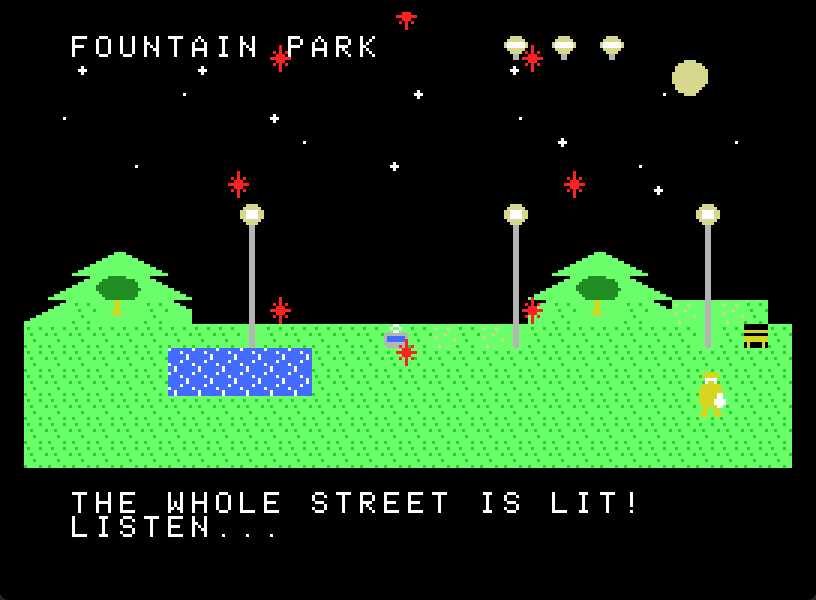 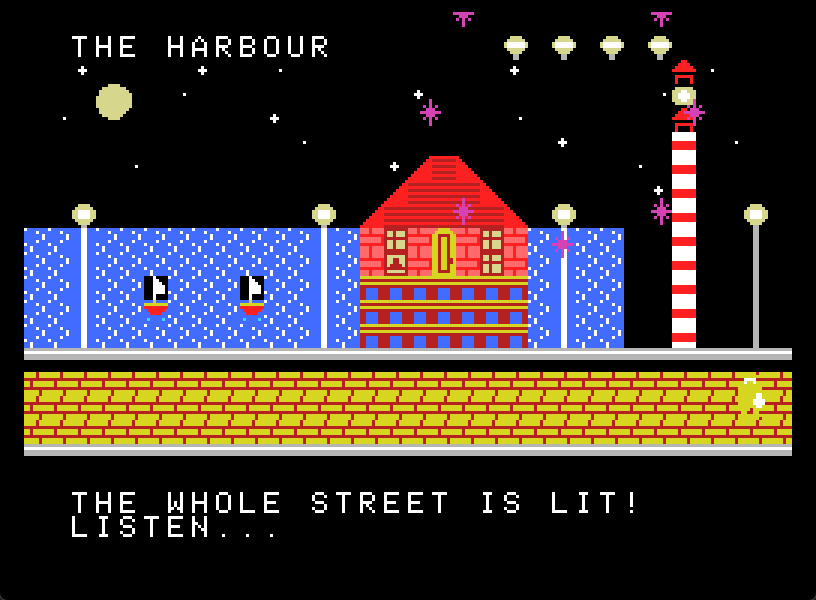 |
|
|
Tonight on the show: a new mystery somewhere in Canada, such as a brass lighthouse lens taken from a museum, and a deadline to find out who is behind it. Follow the trail across 11 Canadian destinations. At each stop, choose among three places to investigate and talk to the witnesses there. A witness with a useful hint costs two hours, one without costs one, and the lead you get rules out the wrong trips. Travel to the right destination costs three hours, and a wrong trip four, for the round trip, though you keep your clues. Collect the clues that single out one of six fictional suspects, file your alert and name the right person before time runs out. The atlas, the dossier and the menus are free.
There are 32 cases, each a three-leg route with its own suspect and clues, and a new episode never repeats the last one; RETRY CASE plays the same case again. On HARD, every witness costs two hours and a wrong trip five, with the same cases and deadlines. A solved case scores 1,000 plus 25 for every hour left; you can also run out of time, accuse the wrong person, or forget to file the alert. Controls: either controller. The joystick moves up and down the menus, button 1 chooses and button 2 goes back. No keypad is needed. An original game designed by Amy for Amy Studio and programmed in Amy, the language by Amy Bienvenu, by Claude (an AI made by Anthropic), 2026, with the title theme by Amy. This is a modern homebrew release, not a commercial Coleco release. |
Amy Studio/Amy Purple (Bienvenu) | 31kb |     |
|
|
A summer night over the meadow. Fireflies drift and blink. Carry your jar to a firefly while it glows and press the button to catch it, and the jar fills with light. A firefly that has gone dark simply slips past the jar, so wait for it to glow again. With twenty in the jar, you open it and let them all go home to the sky.
It is a gentle game with no enemies and no timer: nothing chases you, and there is no hurry. Controls: either joystick. The stick moves the jar; either button catches a firefly. The keypad is not used. An original game by Claude (an AI made by Anthropic) for Amy Studio, written in Amy, the language by Amy Bienvenu, 2026, with the music Meadow Lullaby. This is a modern homebrew release, not a commercial Coleco release. |
Amy Studio/Amy Purple (Bienvenu) | 6kb |    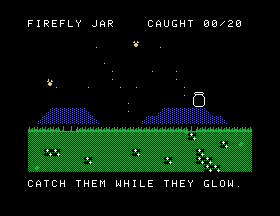 |
|
|
Beneath the mountain town of Hollowmere, the old bell has started ringing by itself, and each night something climbs out of the mines. You are the town's last warden. Take your sword and your lantern, go down, and find out who rings the bell.
Deepwarden is a first-person dungeon crawler with real-time fighting in smooth ray-cast tunnels: swing your sword, block, or fire a lantern flare that stuns. Rats crawl back out of their burrows until you smash the burrows; skeleton miners and light-hating Bell-wraiths roam the workings, and a skeleton foreman guards the stairs. Secrets hide behind cracked walls, loose stones and glowing runes, and an automap fills in as you explore. The soundtrack switches between exploring, combat and the boss without missing a beat, and a speedrun timer keeps your best time and most secrets for the session. This teaser is one complete floor of the upper mine workings, on a standard 32K cartridge. The full game, in development on a 128K MegaCart, adds the grey deep galleries and a bell-cult temple, bats, spiders, hooded cultists and the Bell-Ringer's Servant, parries and ripostes, and a Stonebreaker rune to find on every floor. Controls: the joystick or the Super Action Controller. An original game by Claude (an AI made by Anthropic) for Amy Studio, written in Amy, the language by Amy Bienvenu, 2026. This is a modern homebrew release, not a commercial Coleco release. |
Amy Studio/Amy Purple (Bienvenu) | 31kb |  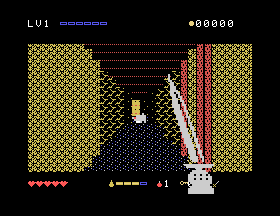 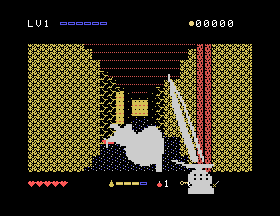 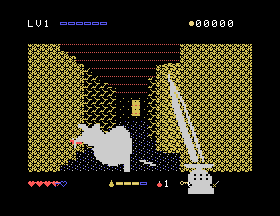 |
|
|
You are lost in the Deep Halls. Each of the four halls has one way out, a yellow door, and you see the hall from inside in first-person 3D. Walk the corridors, use the compass to keep your bearings, and hold the button to see a map of the hall with an arrow marking where you stand. A clock runs as you search, and the end screen shows your total time in the halls: the challenge is how fast you can get out of all four.
The view is ray cast: 32 rays a frame through a 16 by 16 map, each ray's distance choosing a ready-made column of tiles. Each frame is drawn on a hidden screen page and then shown, so the picture does not tear. Controls: either joystick. Stick up walks on, stick down steps back, left and right turn; hold the button to see the map. An original game by Claude (an AI made by Anthropic) for Amy Studio, written in Amy, the language by Amy Bienvenu, 2026, with the tune Echoes also by Claude. This is a modern homebrew release, not a commercial Coleco release. |
Amy Studio/Amy Purple (Bienvenu) | 13kb |    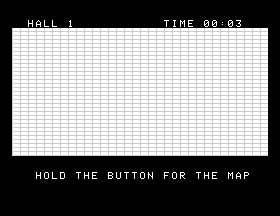 |
|
|
A dungeon crawl through twenty-six levels, A to Z, each a maze of four rooms shown one screen at a time. Monster pits keep sending out demons, wraiths and ghouls. Each arrow knocks a monster down one rank, from demon to wraith to ghoul to gone, and three arrows close a pit for the rest of the level. Keys open the doors, food restores health, treasure chests score, and a potion destroys every monster in the room. Find the stairs down on each level and escape from level Z.
It is in the spirit of Dark Chambers (Atari, 1988) and its ancestor Dandy (John Howard Palevich, 1983), but not a port: the dungeons, graphics, sounds and music are new. It uses flip-screen rooms instead of a scrolling maze and is for one player. The levels are built ahead of time from fixed seeds, so every game has the same dungeon, and doors always guard the way to the stairs. The hero never flickers. Controls: either joystick. The stick moves; the left button shoots an arrow; the right button drinks a potion. The keypad is not used. An original game by Amy Bienvenu for Amy Studio, written in Amy, her language, 2026, with the music Into the Deep. This is a modern homebrew release, not a commercial Coleco release. |
NewColeco/Amy Purple (Bienvenu) | 15kb | 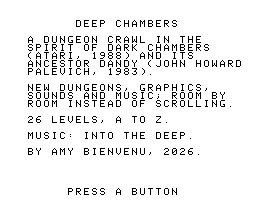 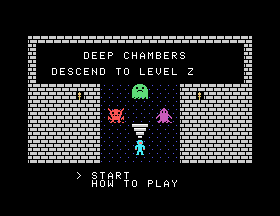 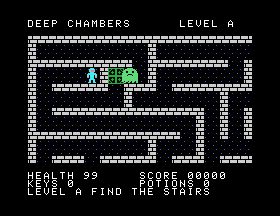 |
|
|
Halloween night. The crows have nested in a stack of crates beyond the field, and you have a slingshot and a pile of jack-o'-lanterns. The camera opens on the crows, pans back to the slingshot, and follows each pumpkin across a field wider than the screen. Glass shatters and lets the pumpkin through; wood cracks, is shoved along, or is broken right through by a hard throw; stone takes a hard throw. A block with nothing under it falls, unless it is held between two blocks or by a neighbour standing on something, and a crow that falls, or that a block lands on, flies off. Now and then one flies straight at the screen.
There are ten stacks. You have three pumpkins for each, four for the last four. Each crow scores 100, a spinning star waiting midway scores 1,000 if a throw hits it, and clearing a stack scores 500 for every pumpkin left. Run out of pumpkins with crows still in the stack and you try that stack again. The field is 80 columns wide and redrawn from the world whenever the camera moves a column. The carved pumpkins glow from inside, and the star's frames were made by turning a real five-pointed star. Controls: either joystick, with two control styles chosen before play. Pinch and pull: hold the button, pull the pouch back with the stick, and let go to throw. Aim and swing: stick up and down aims, holding the button sets the power as it swings up and down, and letting go throws. An original game by Claude (an AI made by Anthropic) for Amy Studio, written in Amy, the language by Amy Bienvenu, 2026, with the camera, the star, the lanterns and the crow at the screen from Amy Bienvenu's ideas, and the music Harvest Moon Jig. This is a modern homebrew release, not a commercial Coleco release. |
Amy Studio/Amy Purple (Bienvenu) | 22kb | 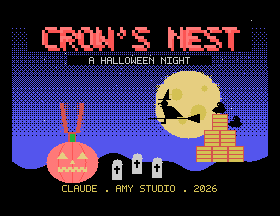 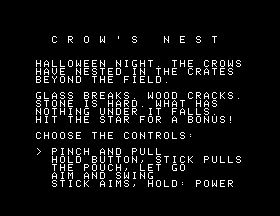 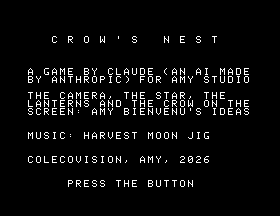 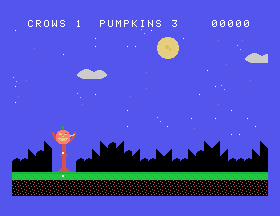 |
|
|
A short demonstration of the ColecoVision's own game option screen. It calls the console's built-in OS7 routine to show the familiar blue screen offering skill levels 1 to 4 for one or two players, eight choices in all, then uses Amy's menu command to put a cursor on it and read the choice. A second screen shows the number of the option selected.
It is a programming example rather than a game: the option screen is the real BIOS screen and only presents the choices, while Amy supplies the cursor, the input and the value chosen. Controls: the joystick on controller 1 moves the cursor and the button chooses; the keypad keys 1 to 8 also choose directly. A demonstration program from Amy Studio, written in Amy, the language by Amy Bienvenu, 2026. This is a modern homebrew release, not a commercial Coleco release. |
NewColeco/Amy Purple (Bienvenu) | <1kb |   |
|
|
Tend a hive through spring, summer and autumn. The bees fly by themselves from the hive to the flowers in bloom and back, and each trip is a drop of honey. You are the keeper: walk about the garden, plant flowers on bare beds for 3 drops from the honey pot, and puff smoke to drive the wasps away before they catch your bees. Every ten drops in a season bring a new bee to the hive.
Each season wants its honey within two minutes: 80 drops in spring, 120 in summer and 160 in autumn, and the wasps come more often as the year goes on. Fall short, or lose every bee, and the year is over; fill all three quotas and the hive is ready for winter. Controls: either joystick. The stick walks the keeper; the button on a bare bed plants a flower, and anywhere else puffs smoke that makes nearby wasps flee. An original game by Claude (an AI made by Anthropic) for Amy Studio, written in Amy, the language by Amy Bienvenu, 2026, with the tune Honey Hum also by Claude. This is a modern homebrew release, not a commercial Coleco release. |
Amy Studio/Amy Purple (Bienvenu) | 10kb |  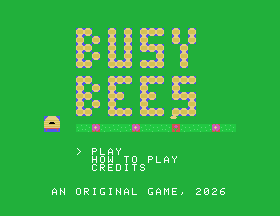  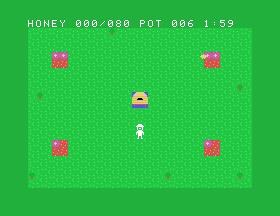 |
|
|
The avalanche has broken loose above you: ski down ahead of it and warn the village below before it buries you. The snow rushes toward you in first-person perspective, and the piste bends left and right between walls of forest. Trees and rocks on the piste throw you over, and the deep forest is slow. Ski between a pair of flags, a gate, for 100 points and a little extra speed.
The avalanche is always behind you: its rumble grows as it gains, and a gauge shows how far back it is. Slow down too much or fall too often and it catches you. There are three stages, each a run down to a village, and reaching the third village wins. The game takes only its theme from AVALANCHE in Tim Hartnell's Giant Book of Computer Games, a turn-by-turn budget game for the mayor of an alpine village; this is a new action game on the same mountain. The perspective ground is made by recolouring the screen line by line every frame. Controls: either joystick. Left and right steer, up tucks for speed and down snowploughs to slow; either button starts and goes through the pages. The keypad is not used. An original game by Amy Bienvenu for Amy Studio, written in Amy, her language, 2026, inspired by AVALANCHE in Tim Hartnell's Giant Book of Computer Games (1984), with the original music First Light on the Col. This is a modern homebrew release, not a commercial Coleco release. |
NewColeco/Amy Purple (Bienvenu) | 15kb | 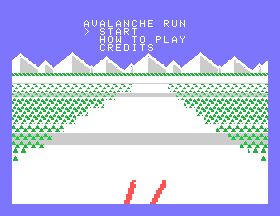 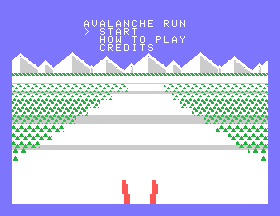 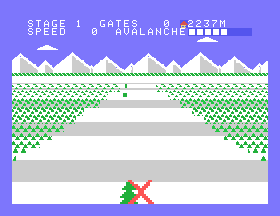 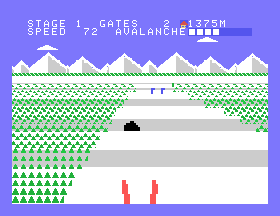 |
|
|
Amy Chess brings a complete chess experience to the ColecoVision, powered by Amy Studio.
Play White or Black against the computer, challenge another player, or watch two computer opponents face each other. Choose between Blitz and Normal computer levels. Full chess rules include castling, en passant, promotion, checkmate, stalemate, repetition and draw conditions. Custom graphics, spoken results, a playful feline welcome and distinct sounds give the game its own personality. |
NewColeco/Amy Purple (Bienvenu) | 31kb |  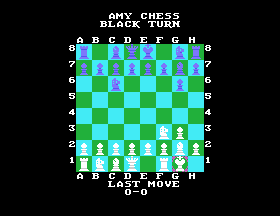 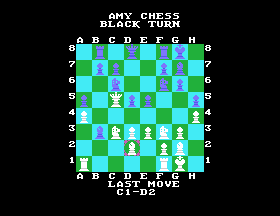 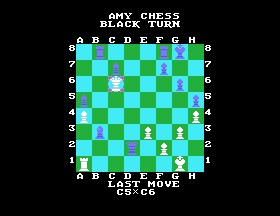 |
|
|
Two pictures shown in 120 colours on the ColecoVision: a sunset harbour drawn for this demo, and the box art of Lamplighter. Press a button to switch from one to the other.
The demo tests Amy's 120-colour mode and its picture converter. Each picture is two 6 KB video memory banks that trade jobs every frame, patterns on one frame and colours on the next, and the eye mixes the two frames into the extra colours. The picture fills the lower two thirds of the screen, 256 by 128 pixels, and the top third stays black, as in the historical 120-colour demos. The pictures are stored compressed and unpacked into video memory when shown. Controls: either button on either controller shows the other picture. The keypad is not used. A demonstration program by Claude (an AI made by Anthropic) for Amy Studio, written in Amy, the language by Amy Bienvenu, 2026. This is a modern homebrew release, not a commercial Coleco release. |
Amy Studio/Amy Purple (Bienvenu) | 6kb | 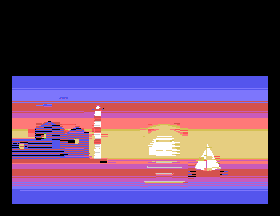 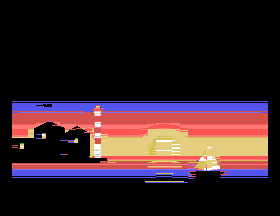   |
|
|
A work-in-progress ColecoVision version of Time Pilot '84, shown as a tile-engine demo dated 27 October 2026. A 512K cartridge image that needs the Super Game Module.
Demo by Toaddio, 2026. This is a modern homebrew release, not a commercial Coleco release. |
Toaddio | 512kb |     |
|
|
A work-in-progress ColecoVision version of Time Pilot '84, shown as a tile-engine demo dated 27 October 2026. A 512K cartridge image that needs the Super Game Module.
Demo by Toaddio, 2026. This is a modern homebrew release, not a commercial Coleco release. |
Toaddio | 512kb |     |
|
|
A 64K MegaCart release of Super UWOL, The Mojon Twins' 2016 game, for the ColecoVision. Its status line keeps a coin count for player 1 and player 2.
This is a separate release from CollectorVision's 2021 port by Alekmaul. ColecoVision release by swerx, 2026. This is a modern homebrew release, not a commercial Coleco release. |
swerx | 64kb | — |
|
|
Space Vanture v3.1 — homebrew ColecoVision space adventure (note: title is "Vanture", not "Venture"). Public-domain freeware.
|
Unknown | 32kb |  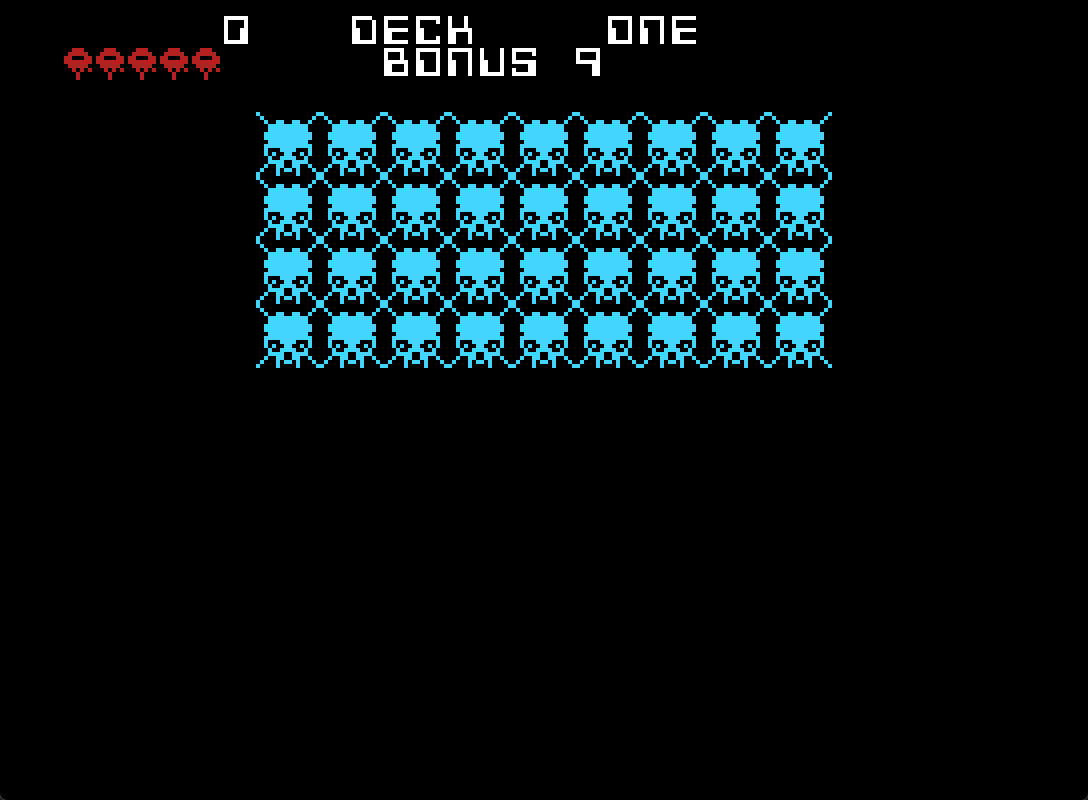  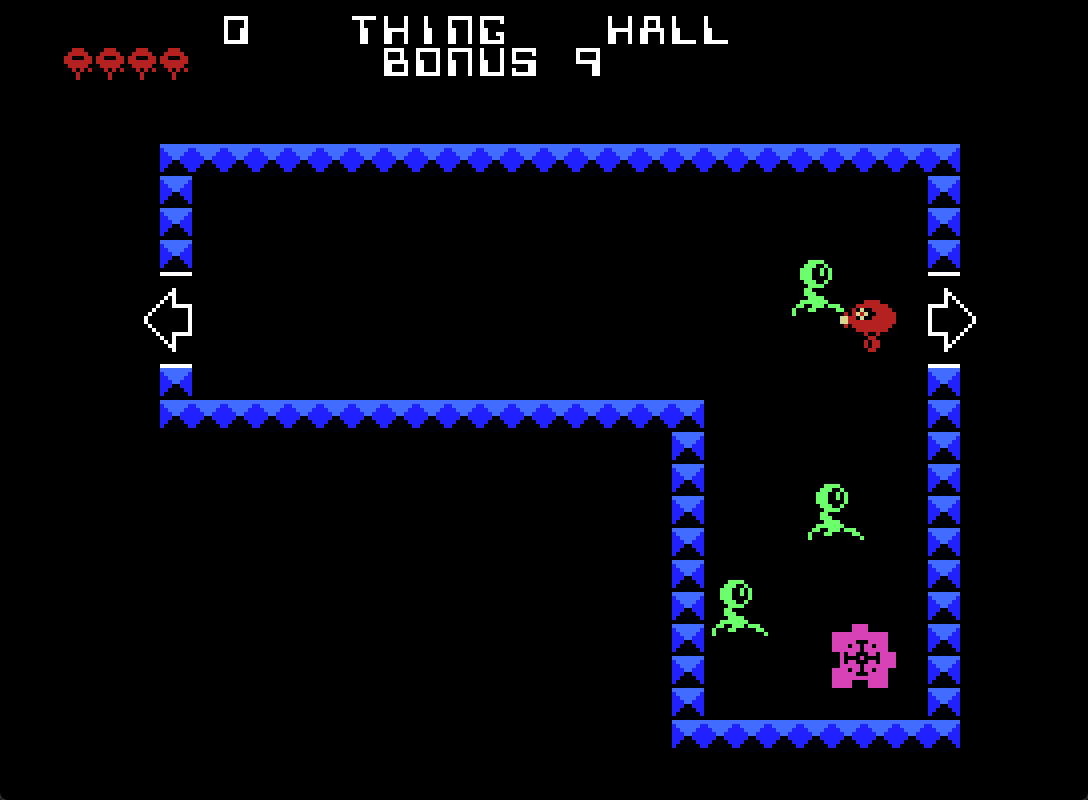 |
|
|
Seasonal Christmas-themed ColecoVision homebrew. The player helps Santa save Christmas through holiday-themed obstacle courses.
|
Unknown | 32kb | 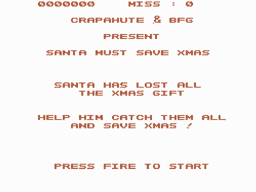 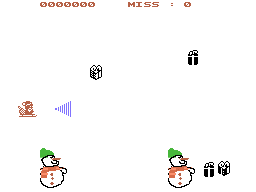 |
|
|
A ColecoVision port of the Casio PV-2000 version of Roc'N Rope. Climb the cliffs with your rope gun, fend off the dinosaurs with your flash and reach the phoenix at the top.
Requires the Super Game Module. Port by Shiddie, 2026. This is a modern homebrew release, not a commercial Coleco release. |
Shiddie | 32kb |  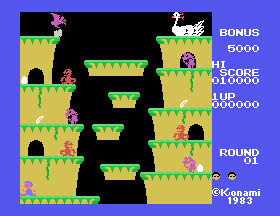 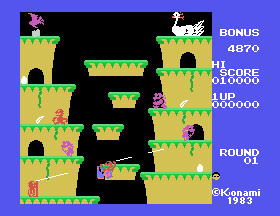 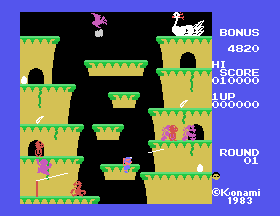 |
|
|
Eat every dot in the maze and dodge the ghosts. Before play, an options screen sets the starting level, the number of lives (1 to 9) and the number of ghosts (1 to 4).
Controls: joystick 1 moves; press the button to begin. A ColecoVision version by unhuman, 2026. This is a modern homebrew release, not a commercial Coleco release. |
Unhuman Claude | 16kb |  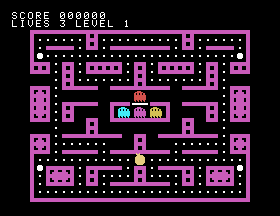 |
|
|
In OBAKE you have to eat all the food items on the screen while dodging the enemies and avoiding the poisonous mushrooms. If you manage to eat two or three items in one bite, you'll get extra points!
Each round features a number of enemy ghosts that will try to catch you, making you lose a life. You get an extra life every 20000 points. There's also a time limit, which is reduced in later stages. You get bonus points for the remaning time when you clear the round. PLAY OPTIONS You can play the game in normal or FAST mode. In normal mode, you start at a reasonable pace, which ramps up in stages 2 and 3. In fast mode, you (and your enemies!) will move fast from the get-go. This gives you the chance to clear the screen faster and score more time bonus points. You can use the CONTINUE option to start where you left off in the last game, but your score will be reset. You can also start directly in STAGE 2 or STAGE 3, and try to finish the game that way! https://andrs-mc.itch.io/obake-colecovision |
Unknown | 16kb |  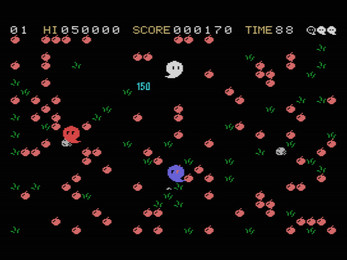 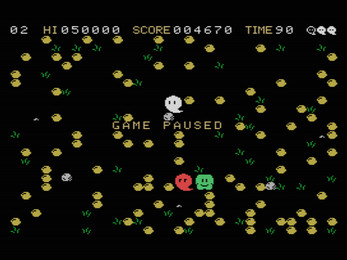 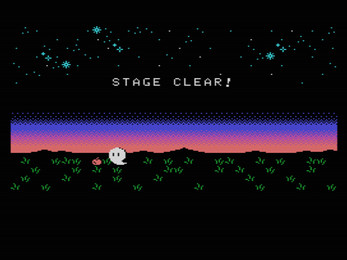 |
|
|
Introducing **ENCHANTED**, a new Sorcery-style game!
A true ColecoVision SGM ROM packed with exciting puzzles. |
Dannyvdh | 256kb | 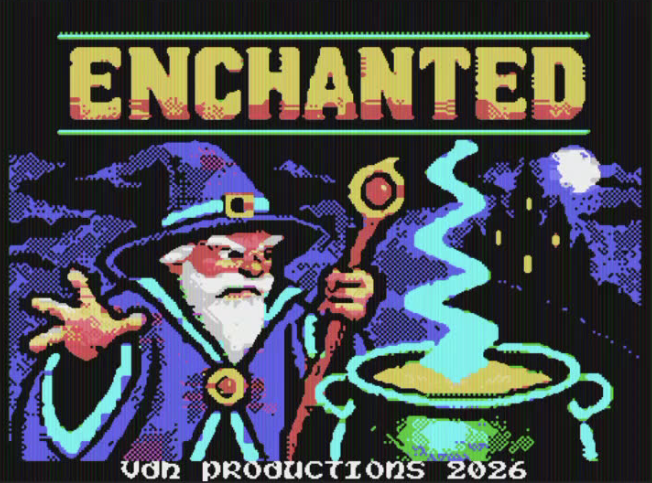 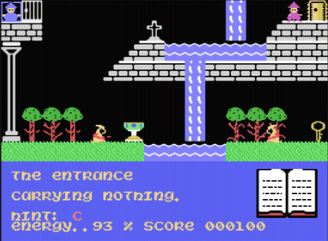 |
|
|
A downloadable Breakanoid. Can you finish all three stages with five balls in this beta demo? Coming soon, more rounds, more music, more hidden goodies, and more fun!
This is still early, with only the first stage available, but after some tweaking I've got it to the point where the logic works the way I want it to... give or take some ropey deflection physics. I'm roughing things out for the moment, but if anyone has suggestions/tutorials on how to properly do deflections in a Breakanoid, it sure would be nifty to have that information! You will need an analog controller (Super Action or trackball). Press a button on the CV controller to serve the ball, then use the dial to move Slim the bat across the playfield. Some bricks have special properties, as follows: BLUE: Awards points, doesn't do anything else. RED: Fires a dart called a "stab," up to four onscreen at once. Do not touch these with the bat. (Not implemented yet) GREEN: Drops a coin. Grab it or concentrate on the ball? Decisions, decisions. (needs a sound effect and polishing up) GOLD: Worth big points, but sets ball in "meteor" status. Don't let the ball get past you! CONCRETE: Deflects ball and is impossible to destroy. Doesn't count against brick total. |
Jesscreations | 32kb | 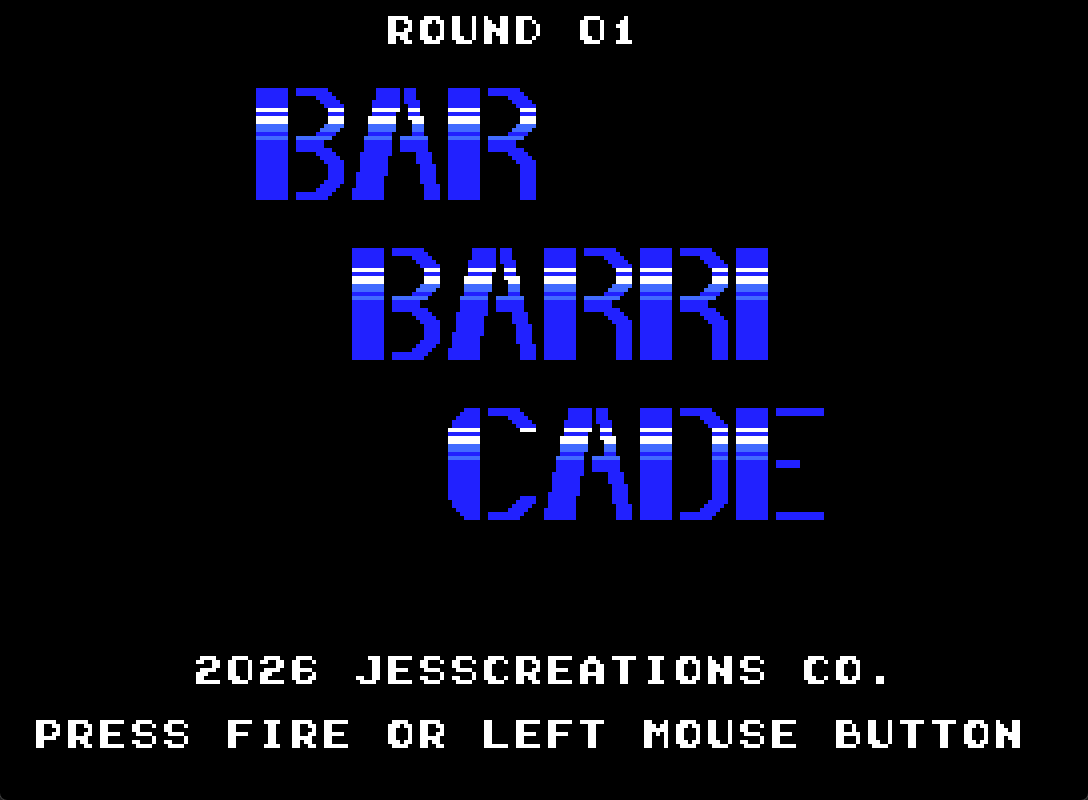 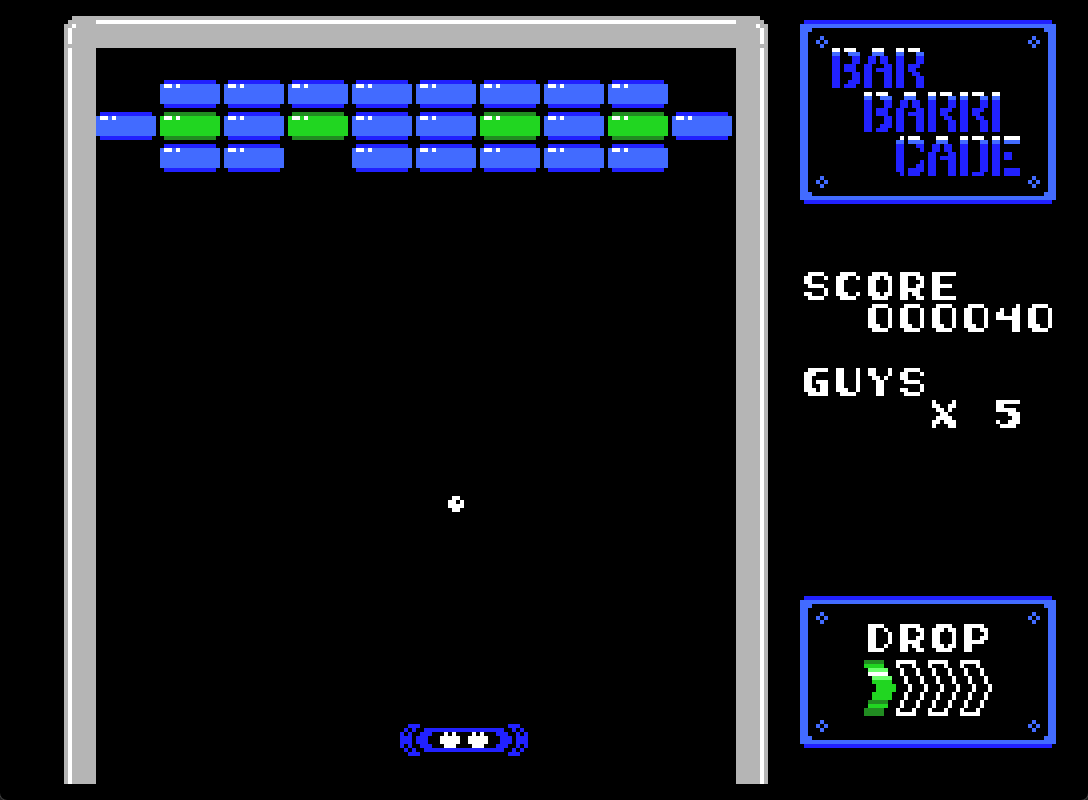 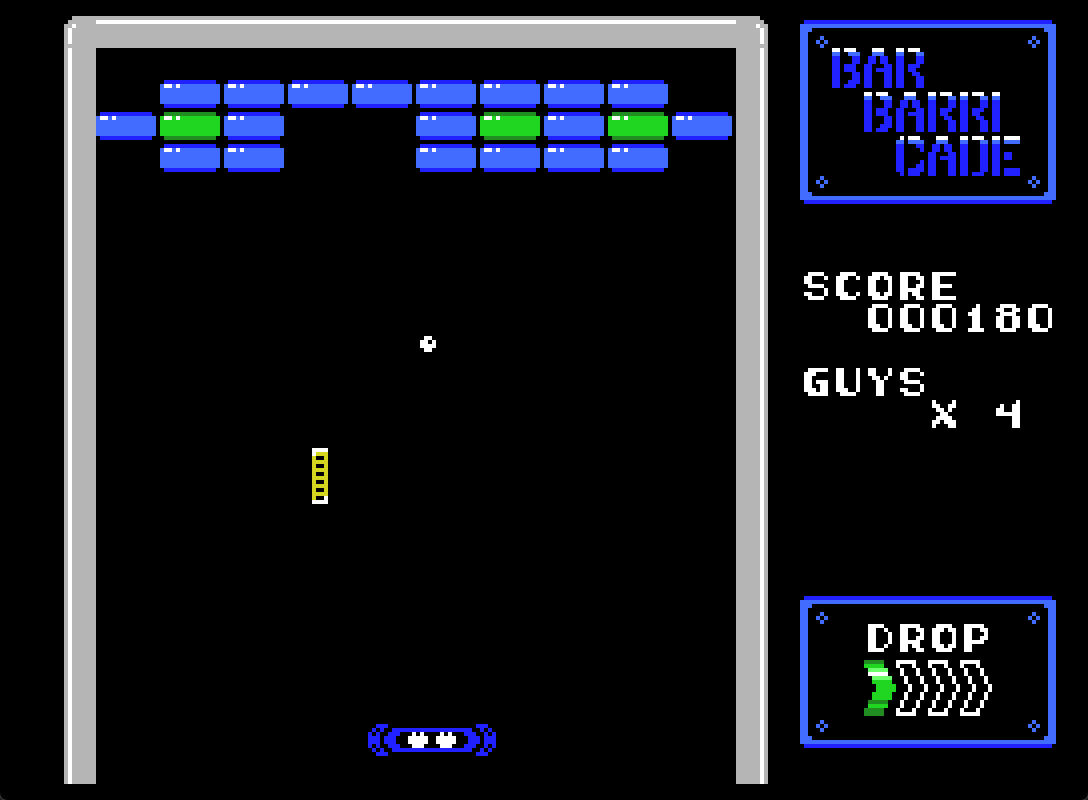 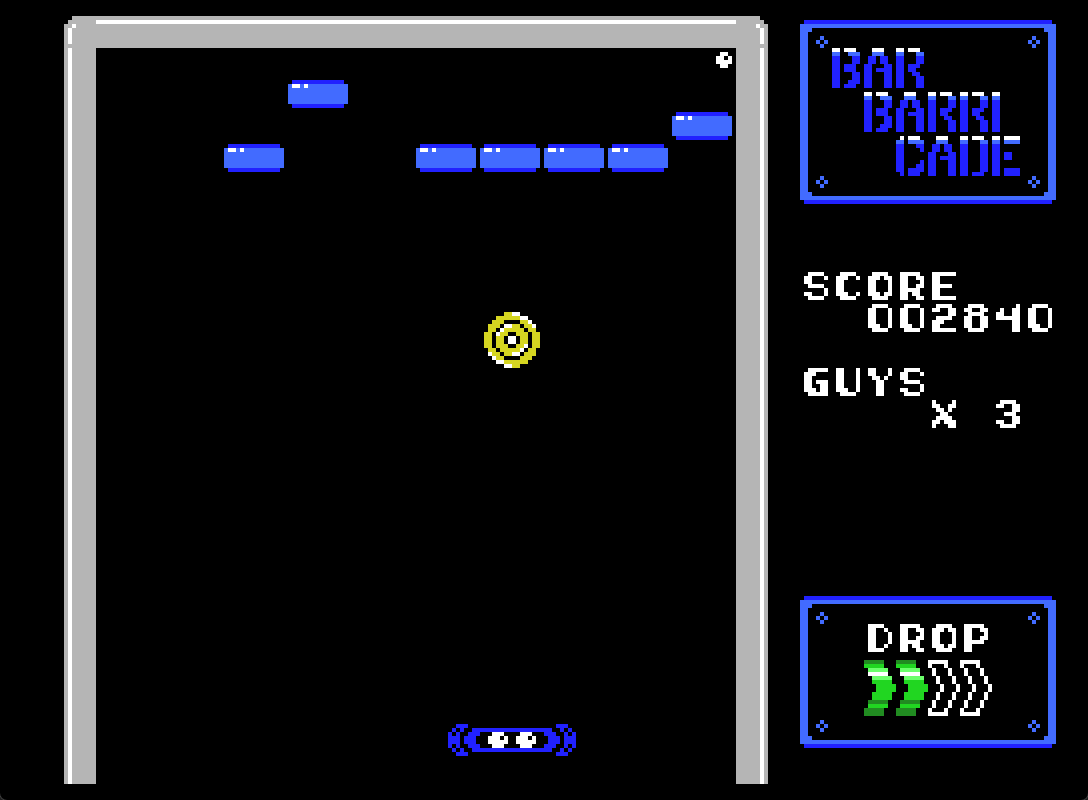 |
|
|
Pilot a ship through a field of drifting rocks and shoot them to pieces before they hit you. A setup screen sets the number of ships and the starting level with the number keys.
Controls: left and right rotate the ship, up thrusts, down jumps to hyperspace and the button fires. The number keys set ships and level on the setup screen. A ColecoVision game by unhuman, 2026. This is a modern homebrew release, not a commercial Coleco release. |
Unhuman Claude | 16kb |  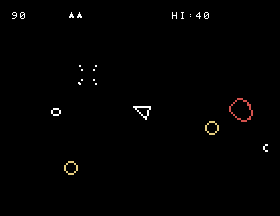 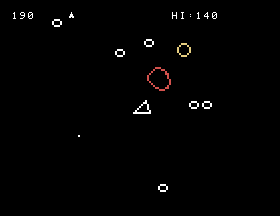 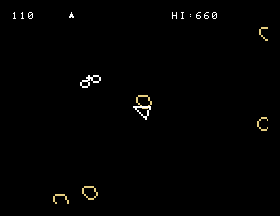 |
|
| 4841kb | 📄 Click to preview |
|||
| 1755kb | 📄 Click to preview |
|||
| 218kb | 📄 Click to preview |
|||
| 127kb | 📄 Click to preview |
|||
| 226kb | 📄 Click to preview |
|||
| 125kb | 📄 Click to preview |
|||
| 328kb | 📄 Click to preview |
|||
| 359kb | 📄 Click to preview |
|||
| 665kb | 📄 Click to preview |
|||
| 226kb | 📄 Click to preview |
|||
| 2291kb | 📄 Click to preview |
|||
| 70kb | 📄 Click to preview |
|||
| 338kb | 📄 Click to preview |
|||
| 8011kb | — |
|||
| 1535kb | — |
|||
| 7978kb | — |
|||
| 1479kb | — |
|||
| 2877kb | — |
|||
| 8801kb | — |
|||
| 7935kb | — |
|||
| 7967kb | — |
|||
| 1283kb | — |
|||
| 1227kb | — |
|||
| 186kb | 📄 Click to preview |
|||
| 160kb | — |
|||
| 25276kb | — |


